How to Crochet for Beginners: A Step-by-Step Guide
Learn crochet from absolute zero with one hook, light-colored yarn,
two foundational stitches, and a small cotton coaster you can finish
as your first useful project.
Written by Sophie Lane•Updated •About 12 minutes to read
Complete beginnerUS crochet termsFirst project included
Crochet is a fiber craft that uses one hook to create fabric
by interlocking loops of yarn. You form one stitch at a time,
which makes it easy to pause, undo a mistake, and continue when you are ready.
At first, coordinating your hands can feel awkward because they have different
jobs. Your hook hand forms each stitch, while your other hand supports the work
and controls how quickly the yarn feeds. However, that coordination improves
through calm repetition rather than a tight grip.
Wondering how to crochet for beginners? This guide starts at absolute zero.
You will choose easy-to-see supplies,
try two common hook grips, make a foundation chain, work US single crochet,
turn your rows, count your stitches, and finish a small cotton coaster.
Skill levelComplete beginner
No previous crochet experience is required.
Main stitchesChain and single crochet
The two skills used in the practice swatch and coaster.
TerminologyUS crochet terms
US single crochet is called double crochet in UK terms.
Recommended yarnSmooth, light-colored #4 yarn
Use cotton for the coaster and cotton or acrylic for practice.
Recommended hook5 mm / US H-8
Adjust only when your yarn label or comfort suggests it.
First projectSmall square coaster
Work rows until the height closely matches the width.
On this page
Step 1
What you need to start crocheting
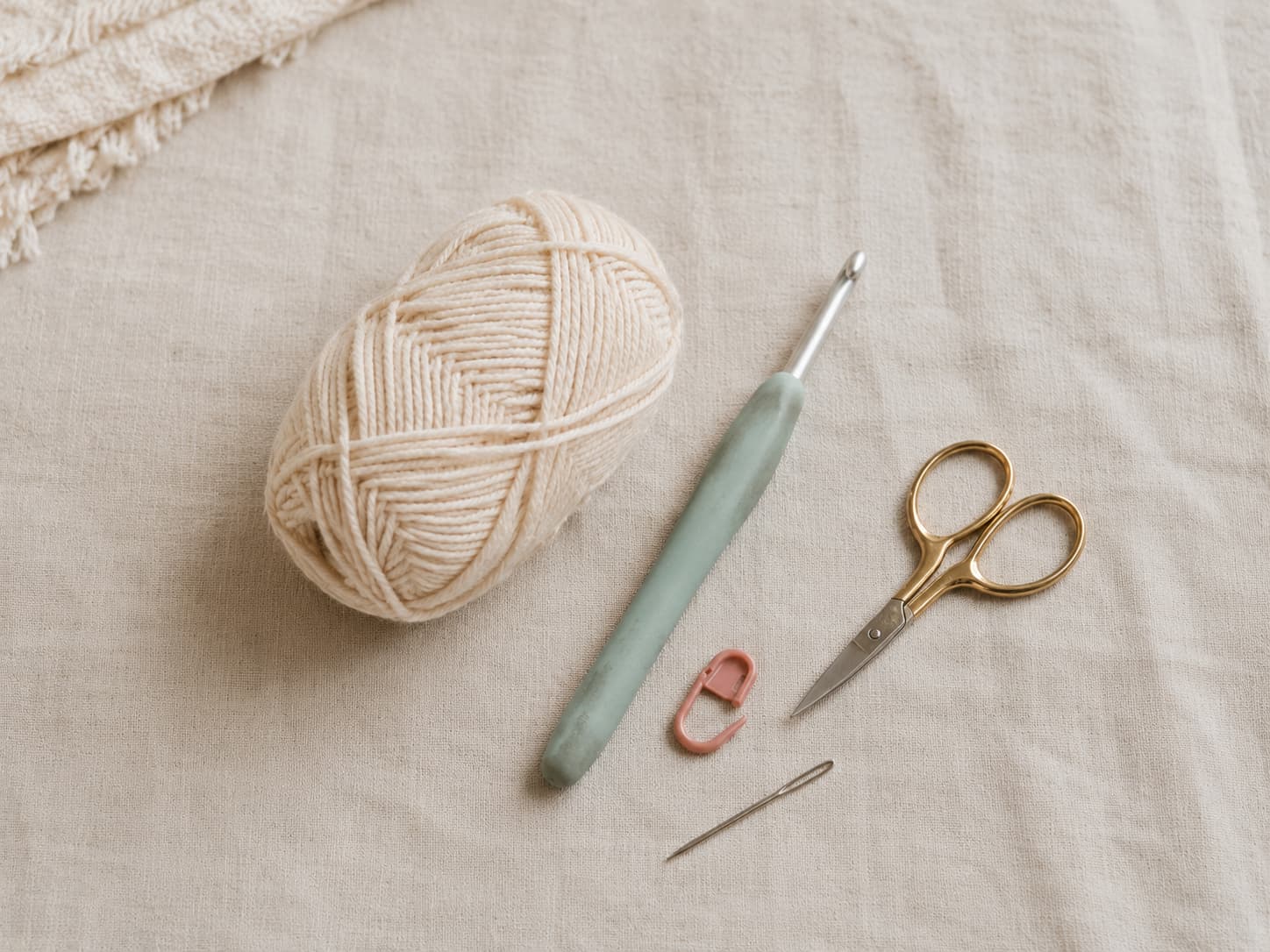
You do not need a large hook set or a basket full of specialty yarn.
Instead, a smooth yarn, one compatible hook, scissors, and a yarn needle
are enough for every exercise in this guide.
Light-colored worsted yarn
First, choose smooth medium-weight yarn marked #4. Cream, oatmeal, pale sage,
and other light solid colors make the top loops easier to see. Cotton
is a practical choice for the coaster because it handles small spills well.
5 mm / US H-8 crochet hook
A simple aluminum hook or a smooth ergonomic hook is suitable.
Although the yarn label provides a useful starting size, your stitches
should remain comfortable enough for the hook to enter without force.
Small craft scissors
Any clean, sharp pair will work. Cut only after you leave a long enough
tail for weaving in securely.
Tapestry needle
Use a blunt yarn needle with an eye large enough for the yarn.
It lets you weave the starting and finishing tails into the fabric.
Start with a small, visible set of tools rather than an oversized beginner kit.
Step 2
How to hold your hook and control the yarn
Crochet uses both hands. Your dominant hand moves the hook, while your other
hand supports the growing fabric and creates enough resistance for the yarn
to form consistent loops. However, there is no single grip that suits every person.
Try the knife grip
Hold the hook with your hand over the top, similar to a table knife.
Then, rest your thumb and index finger near the flat grip area and keep your wrist
as neutral as possible.
Try the pencil grip
Alternatively, hold the hook between your thumb and index finger as you would
hold a pencil. This creates a different wrist motion. Use it only when it feels natural and
does not make your fingers tighten.
Use a simple yarn path
Let the working yarn run over the index finger of your non-hook hand.
You can guide it loosely around another finger for more control, but you
do not need a complicated wrap. The goal is steady movement, not maximum tension.
A comfortable grip controls the hook without squeezing it.
Step 3
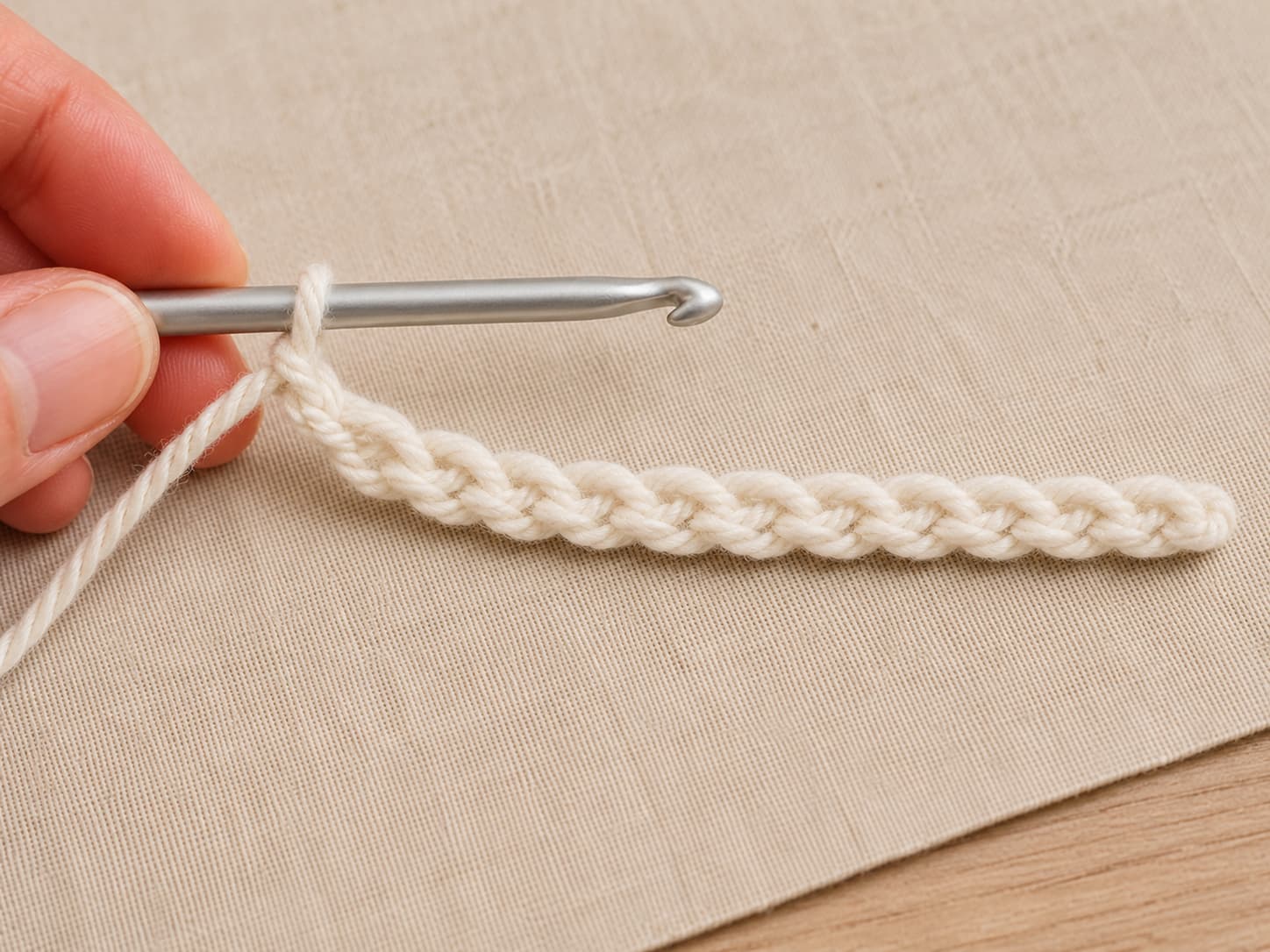
Make your first foundation chain
Next, make a foundation chain, which starts many beginner projects. Each chain forms a small
V-shaped stitch that later receives the first row.
Make a slip knot
First, form an adjustable loop, place it on the hook, and tighten it only enough
to sit securely. The slip knot does not count as a chain
or stitch.
Yarn over
Next, bring the working yarn over the hook from back to front.
Rotate the hook slightly so the hook throat catches the yarn without splitting it.
Pull through the loop
Then, draw the yarn through the loop already on the hook. One new loop remains
on the hook, and one completed chain sits below it.
Repeat and count the V shapes
Finally, continue yarning over and pulling through. Count the completed V shapes below
the hook rather than the live loop currently on the hook.
Count the completed V shapes below the hook, not the working loop.
Step 4
Work your first single crochet
Single crochet, abbreviated sc, creates a compact and sturdy
fabric. Knitsoul uses US terminology. In UK terminology, the same stitch is
called double crochet. The
Crochet & Knitting Abbreviations guide
explains the most common terms.
Insert the hook
For a practice row, insert the hook into the second chain from the hook.
The skipped chain creates turning height and does not count as a stitch here.
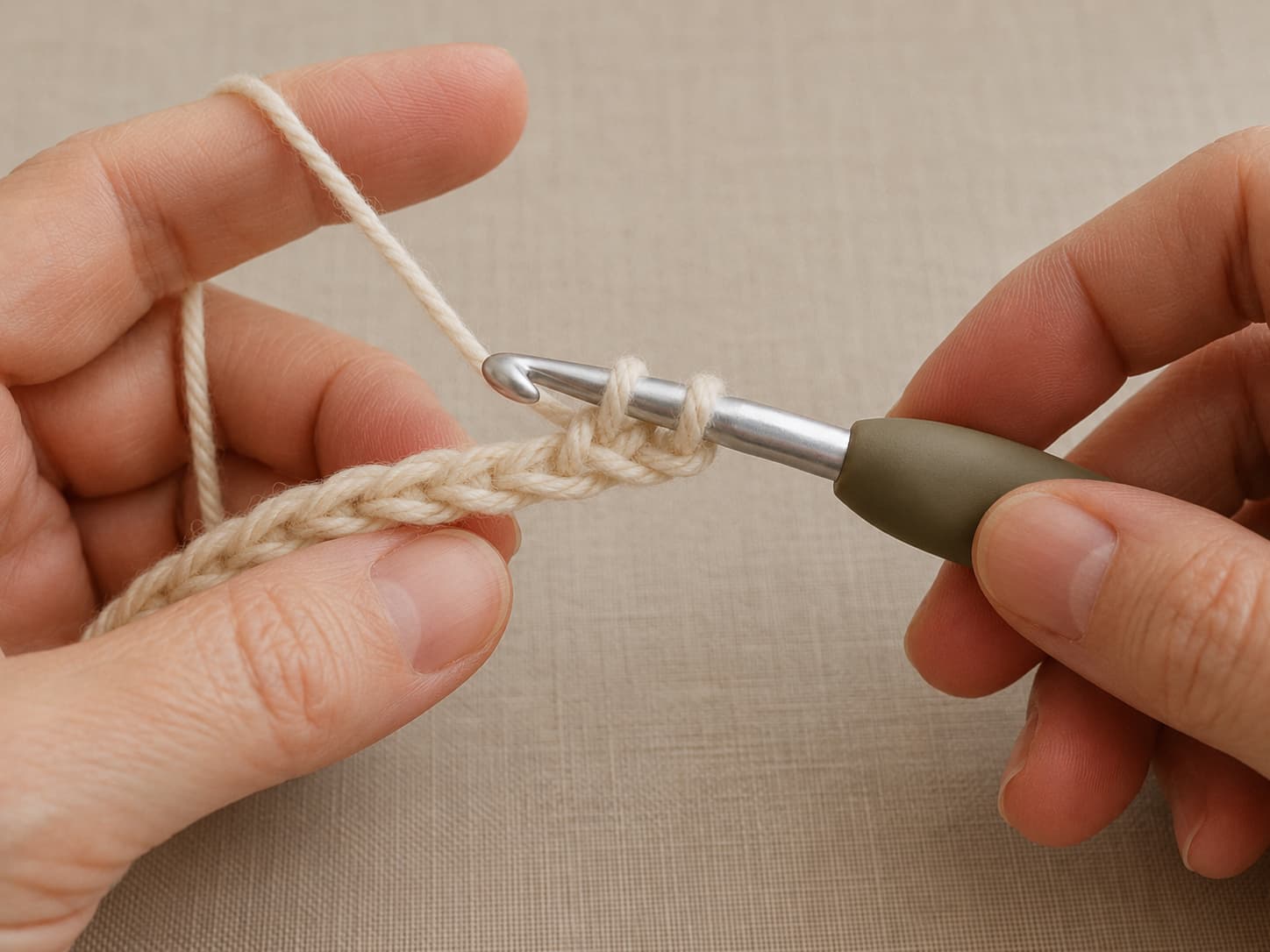
Yarn over and pull up a loop
Yarn over, then draw the yarn through the chain. You should now have
two loops on the hook.
Yarn over again
Bring the yarn over the hook from back to front while keeping both loops
relaxed and easy to see.
Pull through both loops
Draw the yarn through both loops in one smooth motion.
One loop remains on the hook, and one single crochet is complete.
Afterward, continue into every chain across. Count the completed stitches before moving
to the next row. Your first row may twist or vary slightly in height while
the motions are still new.
Two loops on the hook mark the midpoint of a standard US single crochet.
Step 5
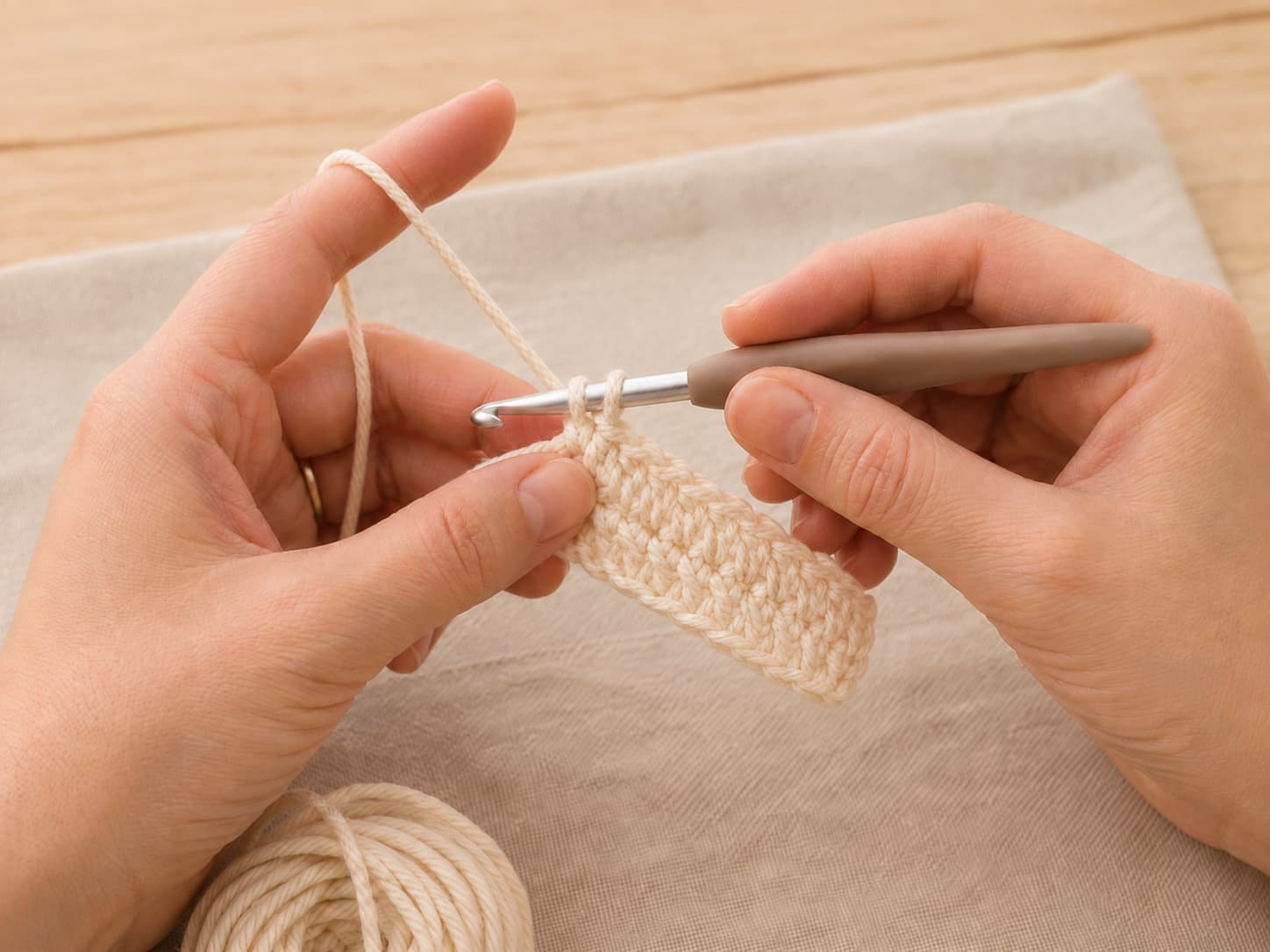
Turn your work and build even rows
Next, at the end of a single-crochet row, chain one, turn the fabric,
and work back across. In this guide, the chain-one turning chain does
not count as a stitch.
Chain one without tightening it against the hook.
Turn the fabric so the opposite side faces you.
Insert the hook under both top loops of the first stitch.
Single crochet across and keep the same stitch count.
First project
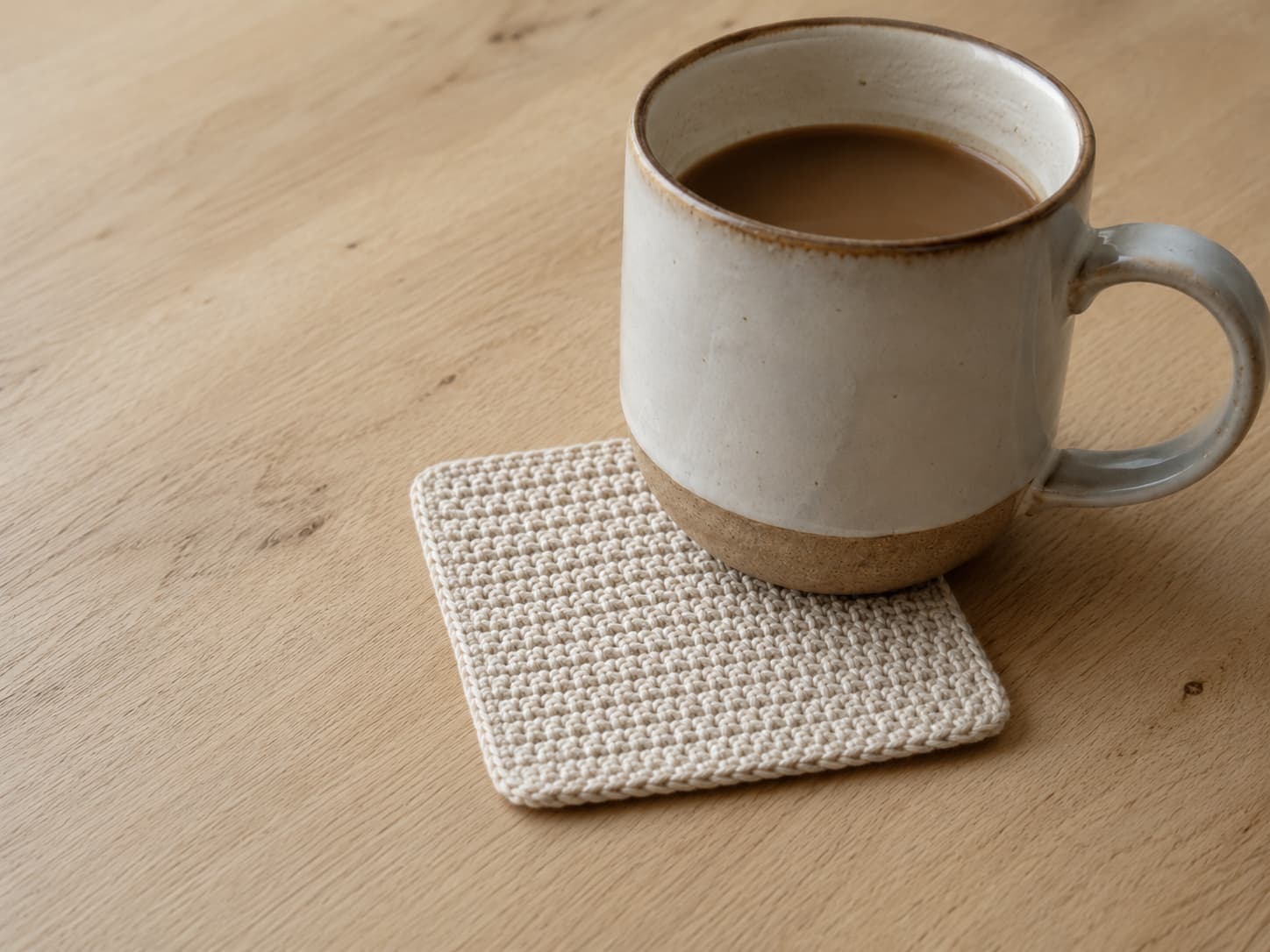
Make a simple single-crochet coaster
This small square uses only the chain stitch and single crochet.
Because yarn, hook material, and hand tension vary, measure the piece
as you work rather than relying on row count alone.
Beginner cotton coaster
US terminology · Worked flat in rows · Turning chain does not count as a stitch
Skill: Complete beginner
Yarn: Worsted-weight cotton
Hook: 5 mm / US H-8
Stitch count: 15 sc in each row
Target shape: Work until height closely matches width
Abbreviations: ch, sc, st, sts
Construction: Flat rows, worked into both top loops
Materials
Small amount of smooth worsted-weight cotton yarn
5 mm / US H-8 crochet hook, or a comfortable size for your yarn
Scissors
Tapestry needle
Optional locking stitch marker
Abbreviations
ch — chain
sc — single crochet
st / sts — stitch / stitches
Instructions
Foundation: Chain 16.
Row 1: Single crochet in the second chain from the hook
and in each chain across. You should have 15 single crochet stitches. (15 sc)
Row 2: Chain 1, turn. Single crochet in the first stitch
and in each stitch across. The turning chain does not count as a stitch. (15 sc)
Repeat Row 2 until the height closely matches the width.
Depending on your tension, this may be around 13–15 total rows.
Fasten off: Cut the yarn, leaving a tail about
6 in / 15 cm long. Pull the tail completely through the final loop
and tighten gently.
Finish: Thread each tail onto the tapestry needle
and weave it through several stitches on the wrong side. Trim only
after the tail feels secure.
A first coaster can be complete and useful even when the stitches are not identical.
Troubleshooting
Six common beginner mistakes and how to correct them
Stitches are too tight
First, relax the hook hand, enlarge the working loop slightly, and consider
trying the next hook size up. The hook should enter without force.
Rows keep getting narrower
Next, count each row and check the final stitch. A marker in the first stitch
makes both outside edges easier to identify.
Rows keep getting wider
Do not work into the turning chain when the pattern says it does not count.
Keep the coaster stitch count at 15.
The fabric curls or twists
Check for missed or added stitches, uneven tension, and an overly tight
foundation chain. After the stitch count is correct, light blocking may help.
The yarn keeps splitting
Rotate the hook so the tip passes cleanly through the stitch, slow down,
and use a smooth yarn with clearly visible plies.
The stitches are hard to see
Move to brighter indirect light and use a smooth light-colored yarn.
Black, navy, fuzzy, and heavily textured yarns hide stitch anatomy.
Build consistency
A calmer way to practice during your first week
First, use short sessions. Ten to twenty focused minutes can be more useful than continuing after your hands feel tired.
Next, count every row. Early counting helps you recognize the first and last stitch before mistakes become buried.
Stay with one terminology system. For consistency, Knitsoul uses US crochet terms unless a comparison is clearly labeled.
Also, undo work without treating it as failure. Pulling back stitches is a normal part of learning tension and stitch anatomy.
Finally, keep the first sample. A dated first swatch provides a useful comparison after several weeks of practice.
Continue learning
What to learn after single crochet
Once you can chain, single crochet, turn, and count a row, add one new skill
at a time. For example, half double crochet and double crochet introduce taller stitches,
while working in the round prepares you for circles and granny squares.
Is crochet or knitting easier for a complete beginner?
The easier craft is the one whose hand motions feel more comfortable.
Crochet uses one hook and is often easy to pause and undo one stitch at a time.
Knitting uses two needles and keeps many live stitches on the needles.
Trying a small sample of each is more useful than assuming one is easier for everyone.
What is the difference between crochet and knitting?
Crochet forms stitches with one hook, while knitting forms interlocking loops
across two needles. Both can make garments, accessories, blankets, and home items,
but the resulting fabric and hand motions are different.
How long does it take to learn basic crochet?
Many beginners can understand the chain and single crochet in one practice session.
However, even tension and reliable stitch counting usually take repeated short sessions.
Progress depends on comfort, practice frequency, and the project you choose.
What yarn is easiest to see while learning?
Choose a smooth, light-colored, solid worsted-weight yarn. Cream, oatmeal,
pale sage, and other medium-light colors make the top loops and stitch posts
easier to identify than black, navy, fuzzy, or highly variegated yarn.
Fixing rows, edges, and stitch counts
Why does my crochet rectangle change width?
A narrowing rectangle usually means a first or last stitch was missed.
In contrast, a widening rectangle often means an extra stitch was added at an edge
or the turning chain was treated as a stitch. Count every row while learning.
Do I need to learn pattern abbreviations immediately?
You only need a few abbreviations for the first project: ch, sc, st, and sts.
Learn additional terms as they appear rather than memorizing an entire glossary.
Keep the abbreviations guide nearby.
Should the turning chain count as a stitch?
It depends on the stitch and pattern. In the coaster in this guide,
chain one does not count as a stitch. Follow each pattern's note and
count consistently from the first working stitch to the last.
You have the foundation
Your first finished rows are real progress
Chain stitches, single crochet, turning, counting, and finishing are not
isolated exercises. Instead, they form the foundation of scarves, dishcloths, bags,
blankets, home projects, and many patterns worked in rows.
Keep your first coaster even when the tension changes across it.
It records the point where your hands began learning the motions.
As a result, the next project will already feel more familiar because you will not
be starting from zero.
Happy crocheting, — Sophie
Keep learning with Knitsoul
Get beginner-friendly lessons and new free-pattern updates
Join the Knitsoul email list for practical crochet and knitting guidance,
new beginner tutorials, and occasional pattern updates.
Unsubscribe at any time.