Easy Crochet Dishcloth: A Beginner's First Project
Crochet a washable cotton dishcloth with the beginner-friendly
Ridge & Smooth pattern. You will practise chains and single crochet,
learn back-loop-only texture, add a simple border, and finish with an
optional hanging loop.
Written by Sophie Lane•Published •About 14 minutes to read
Complete beginnerCrochetApprox. 3–5 hoursFree pattern · US terms
An easy crochet dishcloth is a small, washable square made for everyday kitchen cleaning.
It is a practical first project because the shape is simple, the stitch
repeat is easy to check, and a small tension change will not stop the
finished cloth from being useful.
This pattern is designed around a 25-stitch square. Alternating plain
single crochet with back-loop-only single crochet creates a fabric with
one textured side and one calmer side. As a result, the ridges add surface texture,
while the plain rows keep the cloth flexible enough to wring out and dry.
If you have already worked through how to crochet for beginners,
you know the core movements used here: chain, single crochet, turning,
and slip stitch. The only new technique is single crochet in the
back loop only (sc BLO), explained with a diagram before the full pattern.
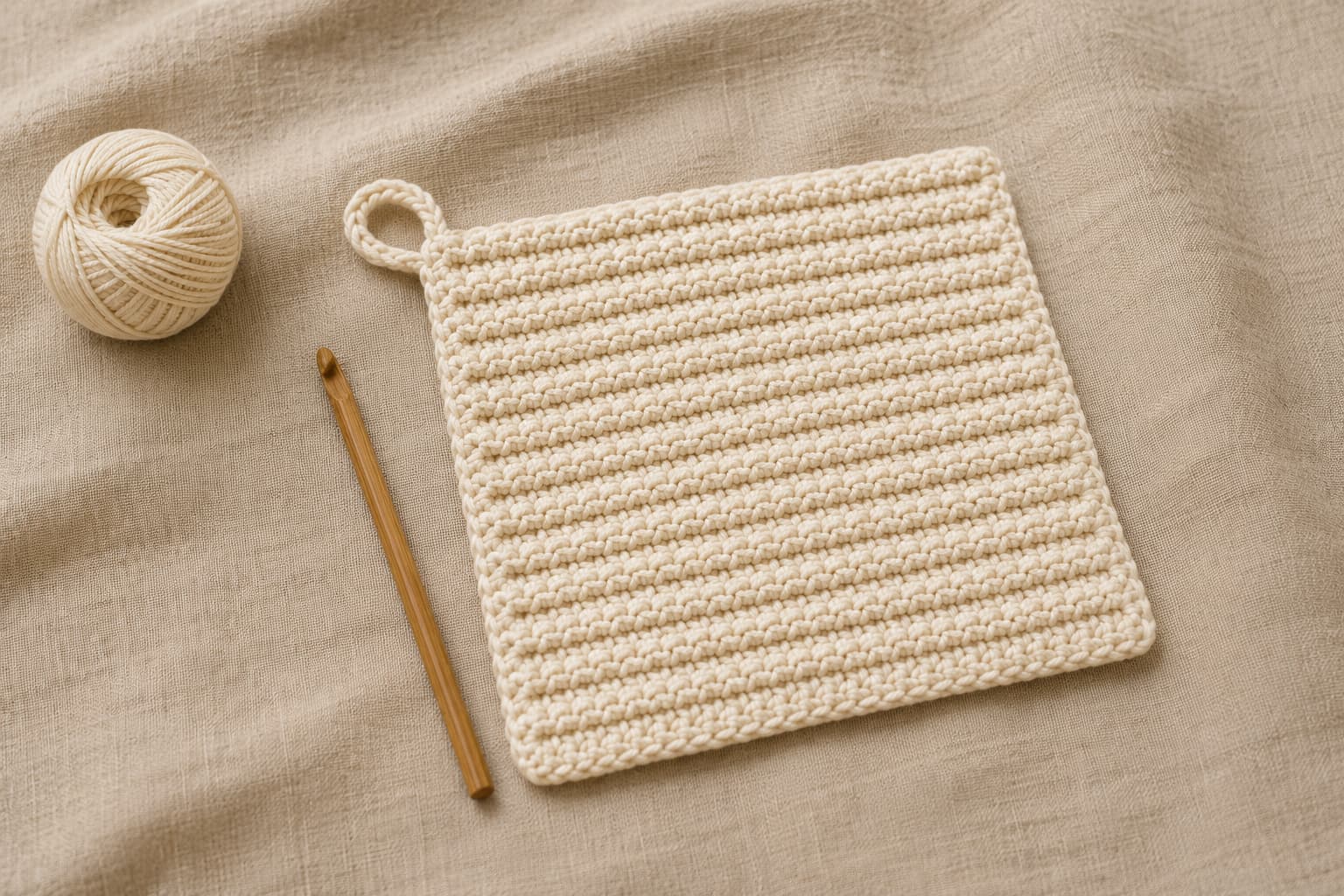
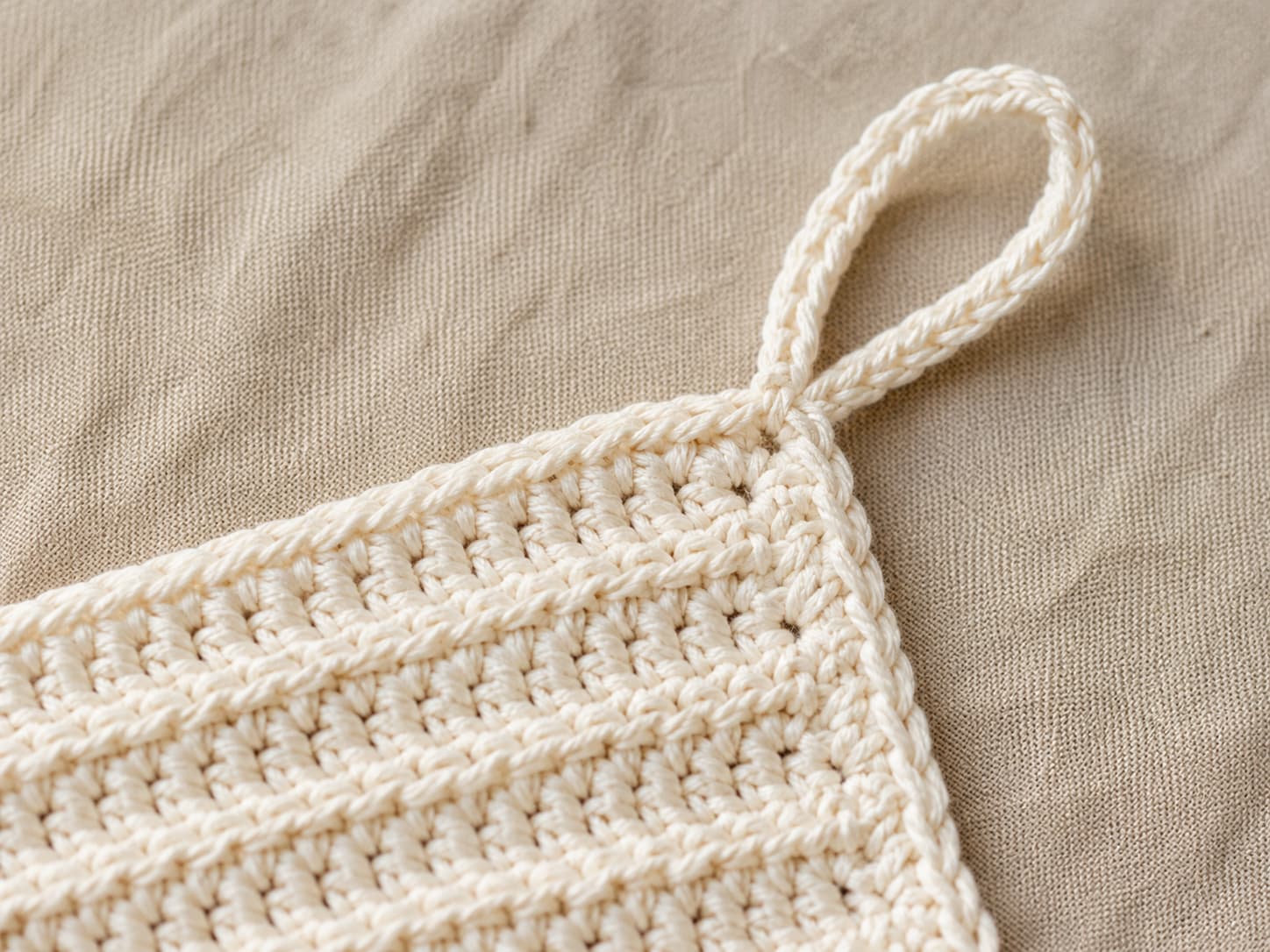
The Ridge & Smooth dishcloth — a one-evening beginner project in #4 cotton.
Skill levelComplete beginner
Your first real project after learning chain and single crochet.
Finished size~18 × 18 cm (7 × 7 in)
A handy square — sizing is forgiving for a kitchen cloth.
Time to makeAbout 3–5 hours
A realistic first-project range; experienced crocheters may finish sooner.
Yarn#4 cotton, ~50 g
Allow roughly 75–90 m (82–98 yd), depending on the yarn and border.
Hook5.0 mm (US H-8)
A comfortable mid-size hook that suits #4 cotton for a soft fabric.
Stitches usedChain, sc, sl st
Plus one easy variation: single crochet in the back loop only (BLO).
On this page
Step 1
What you need to crochet an easy cotton dishcloth
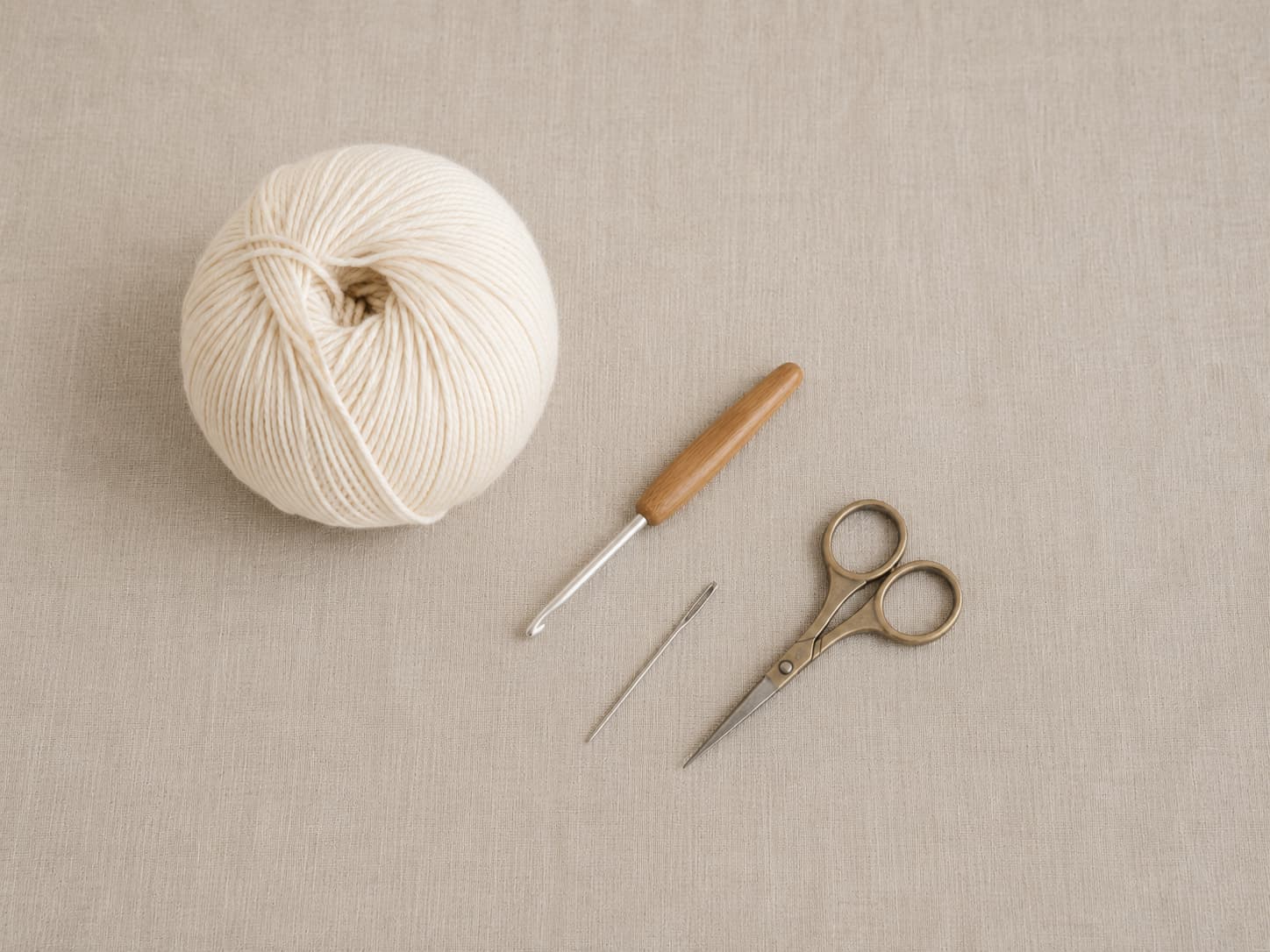
You need only four basic supplies: cotton yarn, a crochet hook, scissors,
and a tapestry needle. First, choose a smooth, light-coloured yarn for the first
sample so the two loops at the top of every stitch remain easy to see.
Cotton yarn
About 50 g / 75–90 m (82–98 yd) of #4 medium cotton. Cotton is a practical
fiber for a dishcloth because it is absorbent, washable, and firm
enough to scrub with. The best yarn for beginners guide explains why cotton is usually more practical than acrylic for wet kitchen projects.
Crochet hook
A 5.0 mm hook (US H-8). This size pairs with
#4 cotton to make a soft, flexible fabric — not too loose, not stiff.
Need help picking hooks? See the yarn & tools guide.
Scissors
Any small pair of scissors with a sharp tip. You only need them twice
— once to cut the yarn at the end and once to trim the woven-in tails.
Embroidery scissors work beautifully.
Tapestry needle
A blunt-tipped needle with an eye large enough for cotton yarn. You
use it to weave in the two yarn tails at the finish. A bent-tip
tapestry needle can make it easier to pass through dense cotton stitches.
For easier counting, a stitch marker is optional but helpful for the very
first stitch of each row — it saves you counting back when you are
learning. A short piece of contrasting scrap yarn works just as well as
a bought marker.
Cotton yarns worth comparing
These three options all work well for the Ridge & Smooth dishcloth.
Availability, shade names, and ball sizes vary by country, so check the
current label before you buy.
Smooth stitch definition
Lion Brand 24/7 Cotton
The current manufacturer specification lists this yarn as #4 medium,
100% mercerized cotton, with 170 m / 185 yd per 100 g ball. Its smooth,
structured strand makes the back-loop ridges easy to identify. The
label gauge uses a 4.0 mm hook; this pattern intentionally uses 5.0 mm
for a more flexible cleaning cloth, so check the fabric rather than
trying to match the label gauge.
The manufacturer lists solid shades at 71 g / 109 m (120 yd) and
ombré shades at 57 g / 86 m (95 yd). Its published crochet gauge is
13 sc × 14 rows per 10 cm with a 5.0 mm hook, which is close to this
pattern's sample gauge. Ball size varies by shade, so compare metres
or yards rather than relying on the ball name alone.
A store-brand or local cotton is suitable when the label identifies
it as #4 medium and the strand is smooth enough to split cleanly into
front and back loops. Allow at least 75–90 m (82–98 yd) so there is
enough yarn for the border and hanging loop. Start with a pale solid
shade; highly variegated colours can hide stitch structure.
Four simple supplies are all this dishcloth needs.
Step 2 · The key skill
The one technique that makes this dishcloth special: single crochet in the back loop
First, look at the top edge of any row of single crochet and you will see two
strands running side by side, like a little letter V at the top
of each stitch. The strand closer to you is the front loop,
and the strand farther from you is the back loop. A
normal single crochet is worked under both loops at once, which
gives you a flat, even fabric.
Next, when you work a single crochet under only the back loop
— usually written as sc BLO — the unused front loop gets pushed
forward and forms a small horizontal ridge on the side of the fabric
facing you. That ridge is the whole personality of this dishcloth. By
alternating a ridge row with a smooth row, you get a soft, textured
cloth that is still simple enough for a first project.
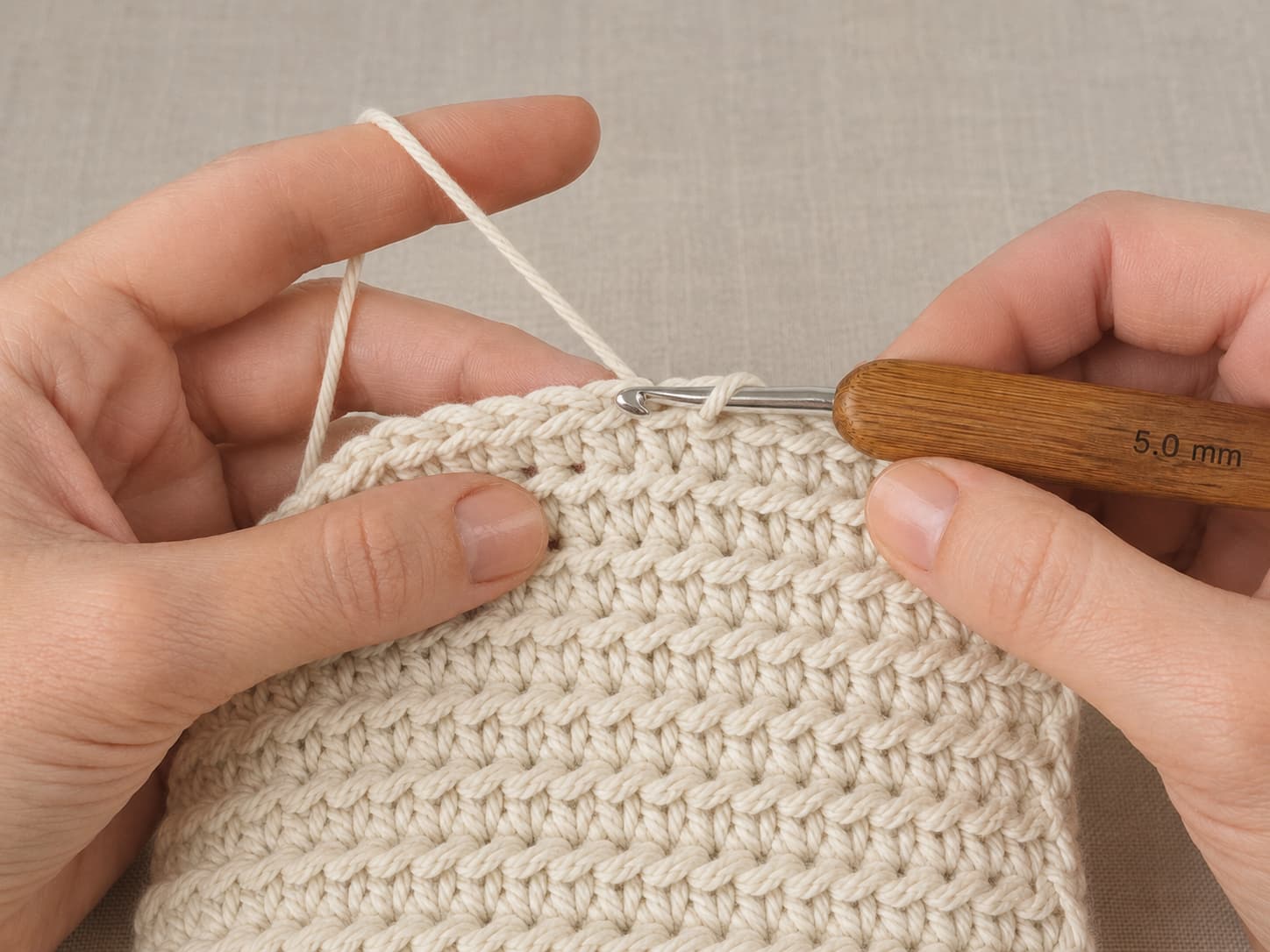
Find and use the back loop
If the hook keeps slipping under both loops, slow down and use the thumb
of the yarn-holding hand to press the front loop forward. Insert the hook
from front to back under only the farther strand, then complete a normal
single crochet. A smooth, tightly plied cotton makes this easier than a
fuzzy or loosely spun yarn.
Keep every ridge on the same side
The unused front loop remains visible on the side facing you while the
BLO row is worked. For that reason, this pattern labels Row 2 as
the right-side texture row and Row 1 as a setup row. Every later
BLO row is worked with the same side facing, so the horizontal ridges
stack on one face of the cloth; the opposite face remains comparatively smooth.
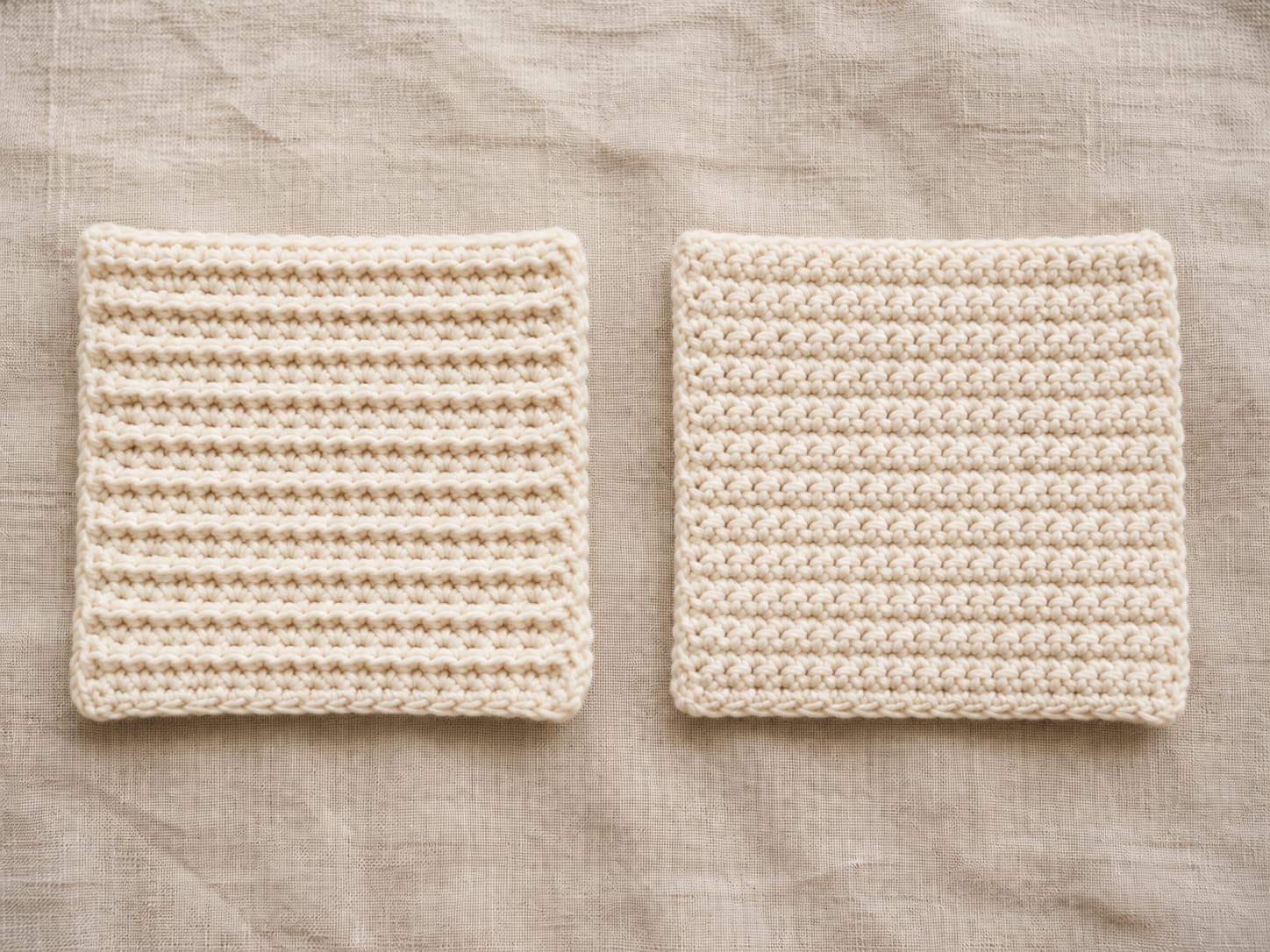
The top of each stitch forms a V. Back loop only means the hook goes under just the far strand — the one that sits slightly higher and farther away.Back-loop-only single crochet (left) raises a ridge; both-loops single crochet (right) lies flat.
Step 3 · The pattern
The Ridge & Smooth Dishcloth pattern
Here is the full pattern in U.S. crochet terminology. It is an original Knitsoul design, written out
row by row so you can follow along without guessing. New to
abbreviations like ch, sc, and sl st?
Pop over to the pattern abbreviations reference
and keep it open in another tab — you will not need it for long.
Work each ridge row slowly at first — your hands will find the rhythm quickly.
Ridge & Smooth Dishcloth
An original Knitsoul beginner pattern · approximately 3–5 hours
Approximately 50 g / 75–90 m (82–98 yd) of #4 medium cotton yarn
5.0 mm crochet hook (US H-8)
Tapestry needle for weaving in ends
Scissors
Abbreviations
ch chain · sc single crochet · sc BLO single crochet in back loop only · sl st slip stitch · RS right side
Instructions
Foundation
First, use the 5.0 mm hook and #4 cotton to chain 26.
Row 1 — setup row (wrong side)
Next, sc in the 2nd chain from the hook, then sc in each remaining chain across. (25 sc)
Row 2 — ridge row (right side)
Then, ch 1 and turn. Sc in the back loop only of each stitch across. (25 sc) The unused front loops form a ridge on the side facing you; mark this as the right side.
Row 3 — smooth row (wrong side)
Ch 1, turn. Sc in both loops of each stitch across. (25 sc) — a flat, smooth row.
The body
Repeat Rows 2 and 3 12 more times. You will finish with 27 rows total: 1 setup row, 13 BLO ridge rows, and 13 smooth rows. End after a smooth row. If your piece reaches 18 cm (7 in) before Row 27, stop after the next smooth row instead.
Border and optional hanging loop
After the final smooth row, do not fasten off. Ch 1 and turn so the textured side faces you.
Work single crochet evenly around all four sides. Aim for about 25 sc along each side, adjusting by one or two stitches wherever needed so the edge lies flat.
Work 3 sc in each corner. At the corner where you want the hanging loop, complete the middle corner sc, ch 12, then sl st into that same sc to close the loop. Finish the remaining corner sc and continue around.
Join with a sl st to the first border sc. Check the cloth on a flat surface before cutting the yarn: if the border ripples, redo it with fewer side stitches; if it pulls inward, add a few.
Finishing
Finally, weave in all yarn ends with the tapestry needle.
If you like, dampen the cloth lightly and lay it flat to dry so the ridges settle evenly.
Design verification: The stitch and row math is
based on the stated sample gauge: 25 stitches ÷ 14 × 10 cm ≈ 17.9 cm,
and 27 rows ÷ 15 × 10 cm = 18 cm. Actual yarn use, post-wash size,
and working time vary by cotton construction and personal tension.
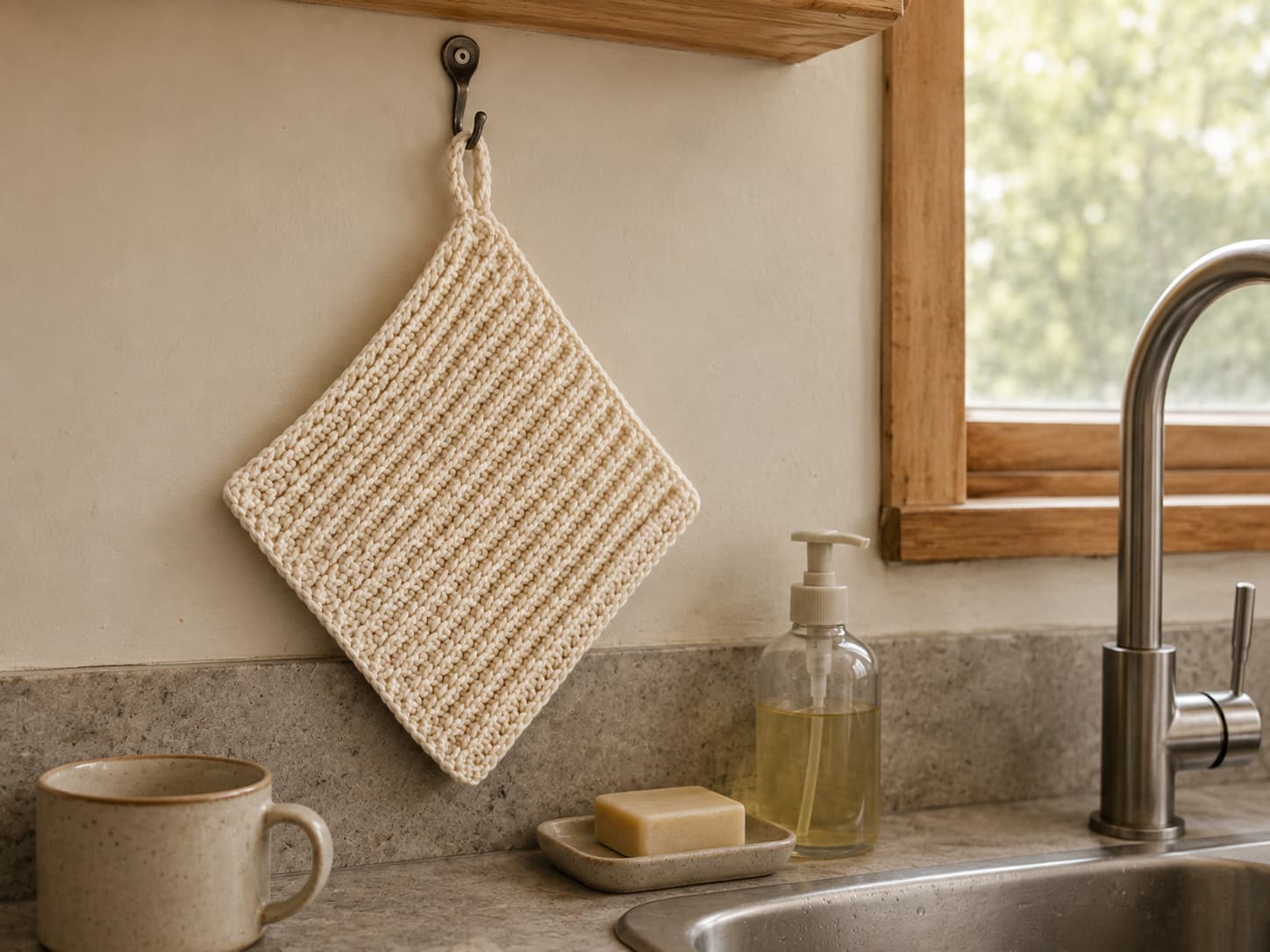
The chain-12 hanging loop lets the cloth dry neatly over a tap or hook.
Troubleshooting
Six common dishcloth mistakes and how to fix them
These six problems are common when stitch count, loop placement, or border spacing changes. None makes the project unusable, and each can be corrected or prevented with a simple check.
Miscounting the starting chain
It is easy to chain 25 or 27 by mistake and end up with the wrong
stitch count on Row 1. Count 26 completed chain stitches; the live
loop on the hook is not a chain. Work the first single crochet into
the second chain from the hook, so one chain is skipped for height
and 25 single crochet remain.
Working both loops on a ridge row
If a ridge is missing, you probably slipped under both loops by
habit. Unravel that row back and redo it as sc BLO. The ridge is
small but visible — once you know what to look for, you will catch
it immediately.
Tension too tight
Cotton has almost no stretch, so tight tension makes a stiff, small
cloth and tires your hands. If your hook resists going into the
stitches, consciously loosen your yarn-holding hand or move up a
hook size. The fabric should flex easily in your fingers.
Losing or gaining stitches at the row ends
The last stitch of a row hides easily because it sits low and close
to the turning chain. Drop a stitch marker into the first stitch of
each row so you always know where the last one will be — and remember
the ch-1 turning chain does not count as a stitch here.
Twisting the foundation chain
A short flat foundation chain can rotate while you work into it.
Before Row 1, let the chain hang naturally and make sure it is not
spiralling around the hook. If it twists, straighten it before the
first row; once several stitches are worked, the edge becomes harder
to reposition neatly.
Uneven border stitches
Too many single crochet along a side edge makes the border ripple;
too few makes the cloth cup inward. Start with about 25 stitches per
side, distribute them evenly, and check the cloth on a flat surface
before fastening off. Adjusting the count is more reliable than
forcing one stitch into every row end.
Practice tips
Practice tips for a neater dishcloth
A few small habits make a noticeable difference in how your finished
cloth looks and feels. They also make it easier to identify where a stitch count or tension change first appears.
Build consistency row by row
First, count stitches at the end of every row until you can
do it without thinking. Twenty-five should be twenty-five, every row.
Catching a missed stitch on row 4 is easy; catching it on row 22 is
heartbreaking.
Next, use a light-colored cotton for your first cloth. The
ridges and the two top loops are far easier to see in cream, oatmeal,
or pale sage than in navy or black, especially under evening lamplight.
Also, keep your hands relaxed. Cotton does not forgive a
tight grip the way acrylic does. If your knuckles ache, set the work
down for ten minutes — tension almost always eases after a short break.
Practice BLO on a tiny swatch first if it feels
fiddly. Chain 11, work two rows of plain sc, then try a BLO row. Ten
minutes of practice makes the real thing feel simple.
Finally, wash and lay flat to dry when you finish. Cotton
relaxes and evens out beautifully in water, and a gentle block makes
the ridges settle into neat parallel lines.
Make a second one straight away. The biggest jump in
neatness comes between your first and second cloth, because your hands
already know where they are going. Making a second cloth immediately is an efficient way to reinforce the same motions while they are still familiar.
Make it yours
Four easy ways to change this dishcloth
Once you have made one Ridge & Smooth cloth, the same recipe bends
in a few useful directions. None of these change the basic idea — they
simply adjust the size, the texture, or the look. Therefore, pick the one that suits
your kitchen, your yarn basket, or your mood.
Make it bigger or smaller
The width is set by the number of single crochet stitches; there is
no stitch multiple. At the sample gauge of 14 sc per 10 cm, a
25 cm (10 in) cloth needs about 35 sc,
so chain 36. A small 14 cm (5½ in) cloth needs about
20 sc, so chain 21. Use the formula
desired width × stitch gauge ÷ 10, round to a whole stitch,
then add one chain for the skipped foundation chain.
Make it plain (no ridges)
If you prefer a smooth, flat cloth, simply work every row
as single crochet in both loops — no BLO rows at all. You get a
classic, even dishcloth that is slightly thinner and dries a little
faster. It is the most forgiving version of all.
Add two-color stripes
Work two ridge rows in cream, then switch to a second color for the
next two rows. To change color, finish the last stitch of the row
with the new yarn, then carry the unused color up the side edge
rather than cutting it. A cotton in muted sage or
terracotta pairs beautifully with cream.
Try taller ridges with hdc BLO
For a chunkier ridge, work the ridge rows as half double
crochet in the back loop only instead of single crochet. Half
double crochet is taller, so the ridges stand up more and the cloth
works up faster — though it uses more yarn and changes the row height. Work until the piece is square rather than following the 27-row count.
Continue learning
Where to go after your first dishcloth
A finished dishcloth is proof that you can follow a pattern from start
to finish — and that is a real milestone. From here, the natural next
steps are to strengthen your basics, understand your materials a little
better, and pick a slightly bigger project. Therefore, use these Knitsoul pages
to keep moving.
Not sure where to go next? The Start Here
page lays out a clear learning path through crochet, knitting, patterns,
and tools, so you always know what to try next.
Common questions
Easy crochet dishcloth FAQ
Making the Ridge & Smooth dishcloth
How long does it take to crochet a dishcloth?
For a complete beginner, the Ridge & Smooth dishcloth takes
about 3–5 hours spread over an evening or two,
because you are working roughly 27 rows of 25 single
crochet plus a border. Once the stitch pattern is familiar, the
same cloth may take about 2–3 hours. The ridge rows
are slightly slower than smooth rows at first, but they speed up
quickly as your hook finds the back loop automatically.
What is the difference between a crochet dishcloth and a knit dishcloth?
A crochet dishcloth is formed with one hook, while a knitted
dishcloth is formed with two needles and a row of live stitches.
Crochet often produces a thicker, more structured fabric; knitting
usually produces a thinner, more elastic fabric. Exact yarn use and
thickness depend on the stitch pattern, gauge, and yarn, so there is
no reliable universal percentage difference. Both crafts make useful
cotton dishcloths; choose the method whose hand movements and fabric
you prefer.
How many stitches and rows are in the Ridge & Smooth dishcloth?
The cloth uses a foundation chain of 26, which gives
25 single crochet per row. You work approximately
27 rows in total, made up of 13 ridge
rows (single crochet in the back loop only) and 13 smooth
rows (single crochet in both loops), plus 1 setup row. That
produces a square of about 18 × 18 cm (7 × 7 in).
Choosing yarn and changing the size
What size hook and yarn do I need for a beginner dishcloth?
Use a 5.0 mm hook (US H-8) with about
50 g / 75–90 m (82–98 yd) of #4 medium cotton yarn. This pairing makes a
soft, flexible fabric that is firm enough to scrub with but not
stiff. If your tension runs tight, try a 5.5 mm hook; if it runs
loose, try a 4.5 mm hook. Always follow the gauge on the specific
yarn label as a starting point.
My dishcloth came out too small (or too big). How do I change the size?
Change the number of single crochet stitches and then add one chain
for the foundation turning height. At the sample gauge of 14 sc per
10 cm, each stitch adds about 0.7 cm (0.28 in).
Adding 4 stitches adds about 2.9 cm (1.1 in), while
adding 8 stitches adds about 5.7 cm (2.25 in).
Work rows until the height matches the width. Hook size can fine-tune
fabric feel, but changing stitch count is the more predictable way
to change dimensions.
Can I use acrylic yarn instead of cotton for a dishcloth?
Acrylic can be crocheted into a cloth. However, cotton is usually the more practical choice for wet kitchen use because it absorbs water more readily. Acrylic may feel less absorbent and can hold onto surface moisture differently. Therefore, follow the yarn label, and never use an acrylic dishcloth as a potholder or near direct heat.
Washing and caring for the finished cloth
How do I wash and care for a crochet cotton dishcloth?
Follow the care symbols on the yarn label. Many kitchen cottons
can be machine washed and dried, but temperatures and bleach guidance
differ by product. Wash the cloth after use, dry it completely between
uses, and avoid fabric softener when maximum absorbency matters.
Retire it when the yarn is worn, damaged, or retains odour after washing.
You are ready
Your first dishcloth is the start of something good
Finished and hung by the sink — exactly where a dishcloth belongs.
Completing this dishcloth gives you a useful piece of fabric and four
transferable skills: keeping a consistent stitch count, turning rows,
identifying the back loop, and working an even border. In addition, those same skills
appear in scarves, ribbed cuffs, textured blankets, and many beginner
home projects.
Small differences in edge shape, ridge height, and loop size are normal
in a first sample. Check the stitch count, wash the cloth according to
the yarn label, and compare the fabric before and after laundering. As a result, that
record will make the second cloth faster and more consistent.
Photograph the finished sample and note the yarn, hook, pre-wash size,
post-wash size, and actual yarn used. These five details turn a finished
project into a reliable reference for future patterns.
Happy crocheting, — Sophie
Free printable + beginner updates
Take the pattern to your hook
Editorial references
Standards used for this pattern
Stitch abbreviations, loop terminology, and the metric-to-U.S. hook
conversion in this article follow Craft Yarn Council standards. Product
specifications are linked to the current manufacturer pages and should
be rechecked whenever the post is materially updated.