Skip to the pattern

Free crochet pattern · reusable everyday bag

Easy Crochet Market Bag: Solid Base, Airy Mesh, Reinforced Handles

Crochet a bottom-up cotton bag with a measured circular base, twenty-four mesh spaces, a solid top band, and integrated handles strengthened for repeated everyday use.

EasyU.S. crochet termsBottom upCategory 4 cotton
Quick answerJump to pattern

Start here

Build strength where the bag needs it and open space where it can stretch

This market bag begins with a seventy-two-stitch single crochet circle. The base changes to twenty-four chain-five mesh spaces, returns to a solid seventy-two-stitch top band, and finishes with two integrated chain handles reinforced by additional single crochet and surface slip stitches.

The photographed sample uses deep jade-teal for the high-wear base, band, and handles; warm oatmeal for the mesh; and a small persimmon accent. These colors connect with current vivid-color interest while the low-saturation yarn, linen styling, and warm wood keep the result within the Knitsoul visual system.
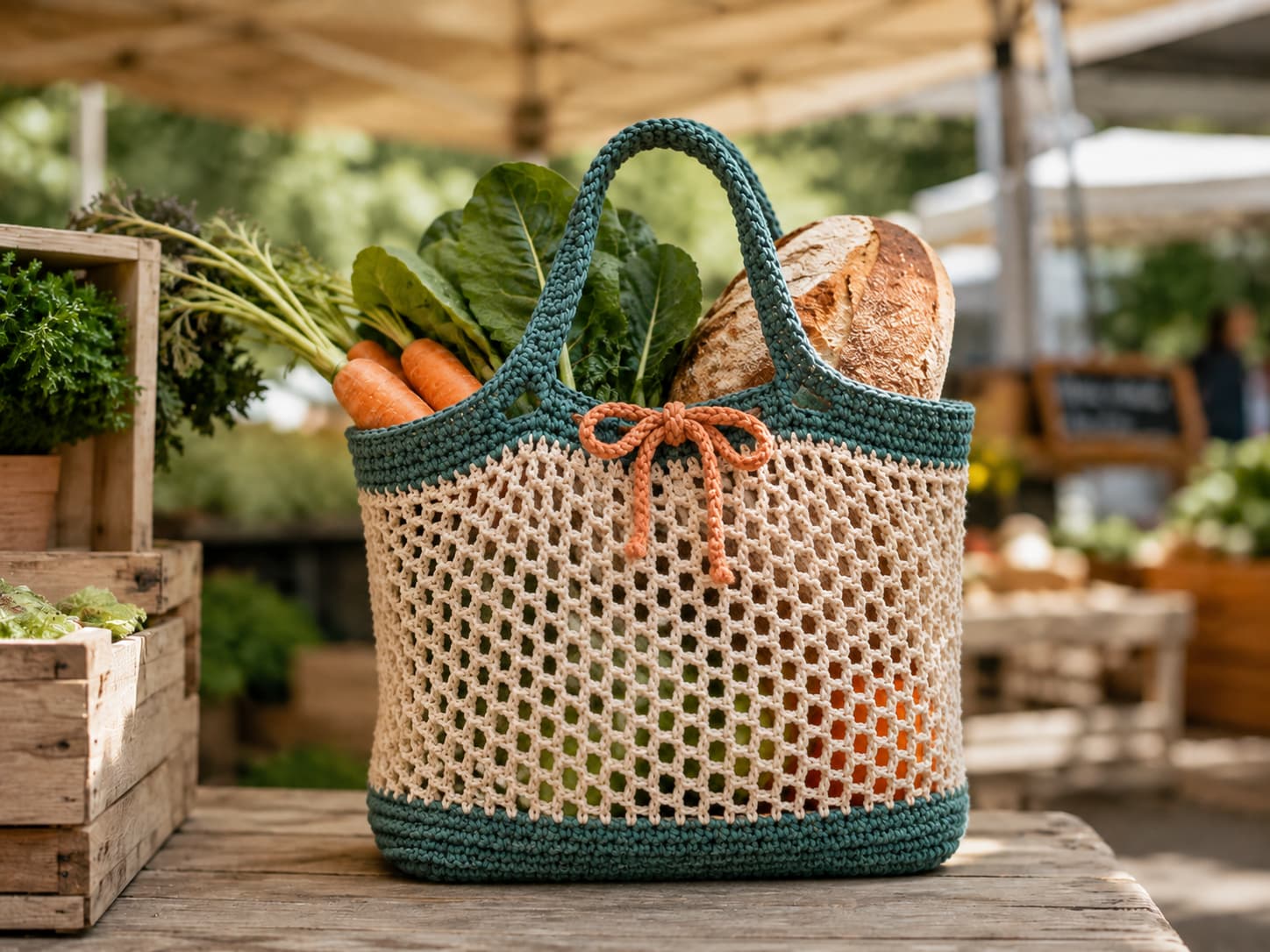
Reusable crochet market bag with a deep jade-teal cotton base and handles, warm-oatmeal mesh body, and a small persimmon drawstring accent holding bread and produce at an outdoor market.
The deep base and handles hide wear, while the lighter mesh keeps the bag airy and the small persimmon accent adds visual energy.
Skill levelEasy

Requires joined rounds, increases, chain spaces, markers, and handle reinforcement.

Yarn300–380 yd cotton

Approx. 275–347 m; verify after the final washed sample.

Hooks4.0 mm + 5.0 mm

Dense base first, then a more open mesh and handle fabric.

Base72 sc

Designed to approach 6 in / 15 cm at the reference gauge.

Body24 mesh spaces

Repeat the same mesh round to the preferred height.

Sample paletteJade · oatmeal · persimmon

Dark structural areas, light mesh, and one small warm accent.
On this page

Construction map

Move through four fabrics without changing the basic stitch vocabulary

Dense circular base

Six increases per round expand a flat single crochet circle from 6 to 72 stitches.

Open mesh tube

Every three base stitches become one anchor and one chain-five space, creating 24 repeats.

Solid top band

Three single crochets in every mesh space restore the count to 72 stitches.

Integrated handles

Two equal chain loops span matching 18-stitch openings and receive reinforcing rounds.

Materials and color

Choose yarn for stability, washability, and visible stitch structure

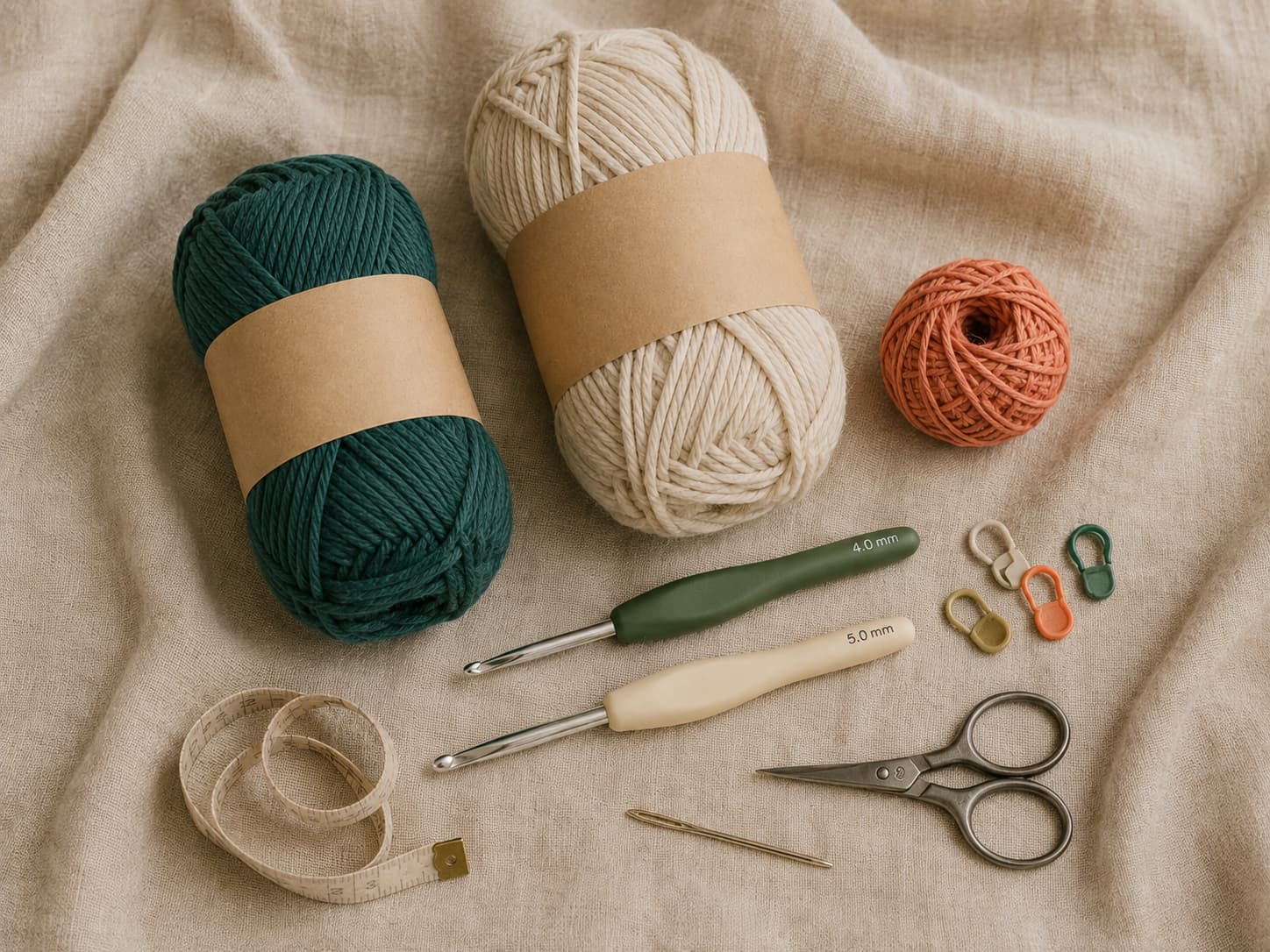
Deep jade-teal and warm-oatmeal medium-weight cotton yarn, a small persimmon yarn ball, 4.0 mm and 5.0 mm crochet hooks, markers, scissors, tape measure, and tapestry needle on natural linen.
Use the smaller hook for the solid base and the larger hook for the mesh and integrated handles.
ItemSpecificationPurpose
Color A140–170 yd / 128–155 m deep jade-teal cottonBase, top band, handles, and optional reinforcement.
Color B170–210 yd / 155–192 m warm-oatmeal cottonAiry mesh body.
Optional accentUp to 10 yd / 9 m persimmon cottonRemovable drawstring or small identification tie.
Base hook4.0 mmCreates a firm lower fabric.
Body hook5.0 mmWorks the mesh, band, and handles.
Notions8 markers, tapestry needle, scissors, tape measureTracks repeats, handle openings, finishing, and measurements.

Gauge and dimensions

Use gauge to control the base and measurement to control the body

Base reference gauge: 16 sc and 18 rounds = 4 in / 10 cm after washing with the smaller hook. Mesh gauge is measured by finished width and height rather than by a conventional solid-stitch swatch.

AreaPlanning measurementVerify on sample
BaseApprox. 5¾–6¼ in / 14.5–16 cmDry diameter and flatness
Mesh heightApprox. 11 in / 28 cm above base edgeUnstretched dry height
Bag heightApprox. 13–14 in / 33–35.5 cm excluding handlesDry centre height
Handle opening48 chains, usually about 10–12 in / 25.5–30.5 cmComfort over hand and forearm

Complete free pattern

Easy Market Bag: written instructions

Knitsoul free pattern

Jade-and-Oatmeal Crochet Market Bag

TermsU.S. crochet terms
ConstructionBottom up, joined rounds
Abbreviationsch, sc, sl st, st, rnd, BLO
Beginning chainDoes not count as a stitch

Base · Rounds 1–2

With Color A and 4.0 mm hook, make a magic ring. Rnd 1: Ch 1, work 6 sc in ring, sl st to first sc. 6 sts. Rnd 2: Ch 1, 2 sc in each st around, join. 12 sts.

Base · Rounds 3–12

Continue adding six stitches per round: Rnd 3 *2 sc in next st, sc in next st* = 18; Rnd 4 *2 sc, sc in next 2* = 24. Continue the same progression through Rnd 12: *2 sc in next st, sc in next 10 sts* around. 72 sts.

Base edge · Round 13

Ch 1. Sc in the back loop only of every stitch around. Join. Change to the 5.0 mm hook. 72 sts.

Mesh setup

Change to Color B. Ch 1, sc in the same st. [Ch 5, skip next 2 sts, sc in next st] 23 times. Ch 5, skip the final 2 sts, sl st to the first sc. 24 sc and 24 ch-5 spaces.

Mesh repeat

Sl st into the first ch-5 space. Ch 1, sc in that space. [Ch 5, sc in next ch-5 space] 23 times. Ch 5, sl st to first sc. Repeat this round until the mesh measures about 11 in / 28 cm from the base edge. 24 spaces every round.

Return to a solid top

Change to Color A. Sl st into first ch-5 space. Ch 1; work 3 sc in every ch-5 space around. Join. 72 sc. Work 3 additional rounds of sc in every stitch, joining each round. 72 sc.

Handle-opening round

Ch 1. Sc in next 9 sts, ch 48, skip next 18 sts, sc in next 18 sts, ch 48, skip next 18 sts, sc in final 9 sts. Join. The two handle openings are opposite and equal.

Handle reinforcement

Ch 1. Sc in each of the first 9 sts, work 48 sc evenly over the first chain handle, sc in next 18 sts, work 48 sc over the second handle, and sc in final 9 sts. Join. Work one more sc round over every stitch, keeping the handle edges relaxed. Fasten off securely.

Optional surface ridge

With Color A, work a line of surface slip stitches along the centre of each handle from one attachment point to the other. Keep the slip stitches loose enough that the handle does not curl.

Technique 1

Keep twelve increase rounds flat and countable

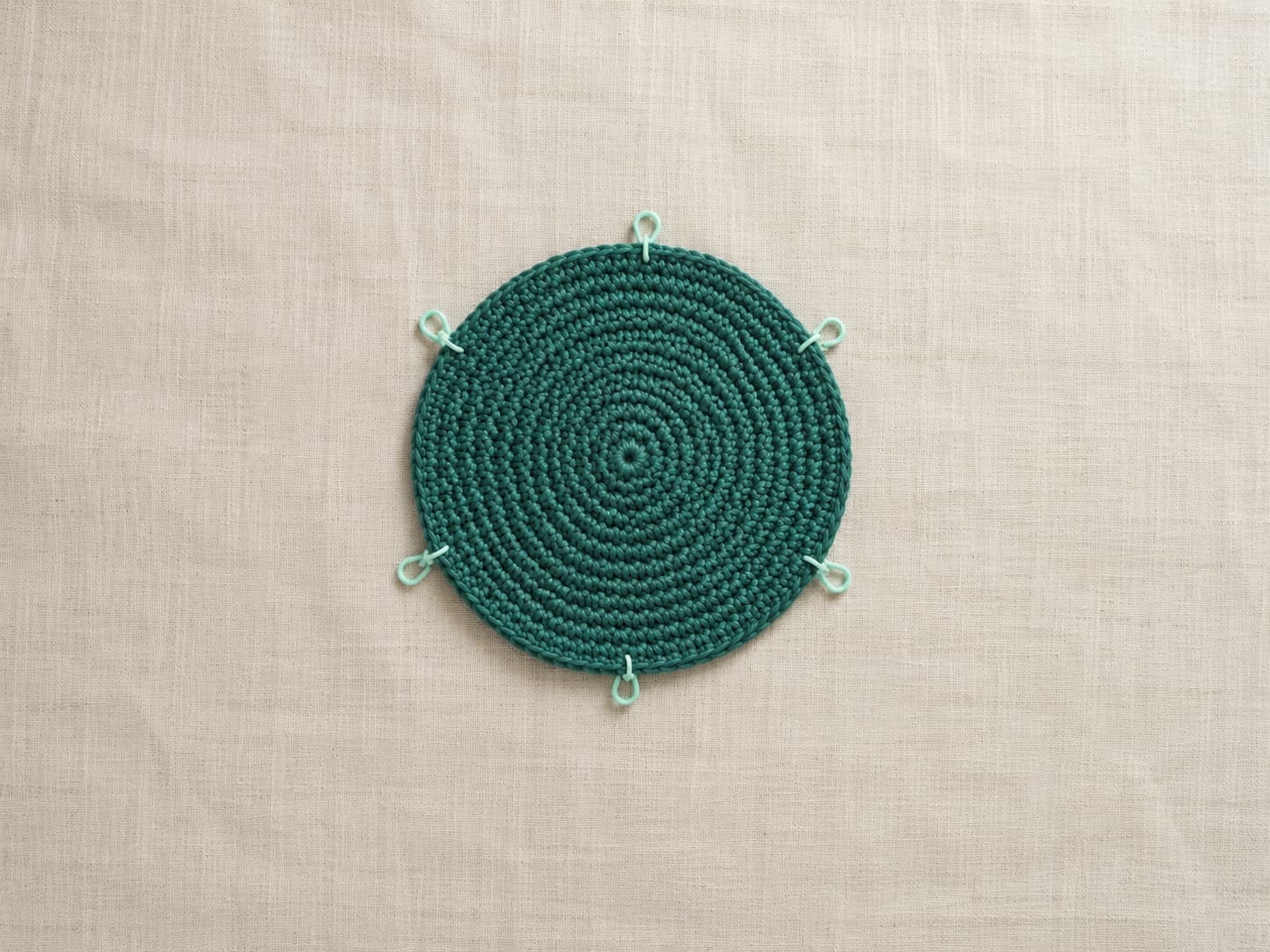
Deep jade-teal crochet market bag base worked as a flat single crochet circle with twelve increase rounds and seventy-two stitches beside evenly spaced markers.
A seventy-two-stitch base is large enough to approach six inches at the stated reference gauge.

Place a marker after every repeat when you are learning the increase sequence. Six repeats per round make an error easier to isolate. When the count is correct but the base cups, first examine tension and hook size; when it ripples, check that you did not work more than six increases.

Technique 2

Anchor twenty-four chain spaces without drifting at the join

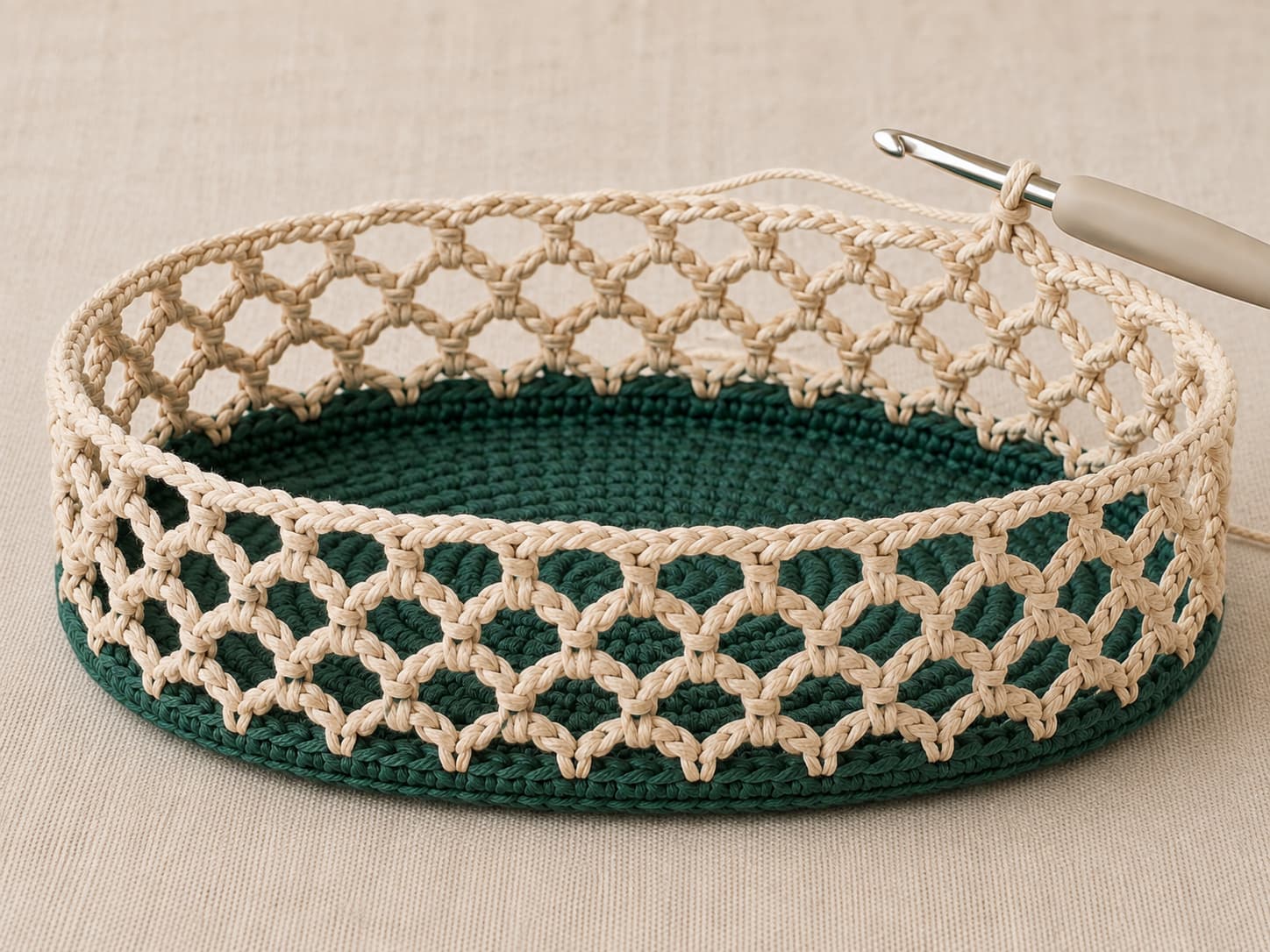
Warm-oatmeal chain-five crochet mesh rising from a deep jade-teal back-loop base edge with twenty-four evenly spaced anchor stitches.
Twenty-four mesh spaces fit evenly around the seventy-two-stitch base because every repeat uses three base stitches.

The setup round is mathematically tied to the base: 72 stitches divide into 24 groups of three. Each repeat skips two stitches and anchors into the third. In later rounds, every new anchor goes into the next chain-five space—not into an individual chain unless the pattern says so.

Technique 3

Balance the openings, then reinforce the complete handle loop

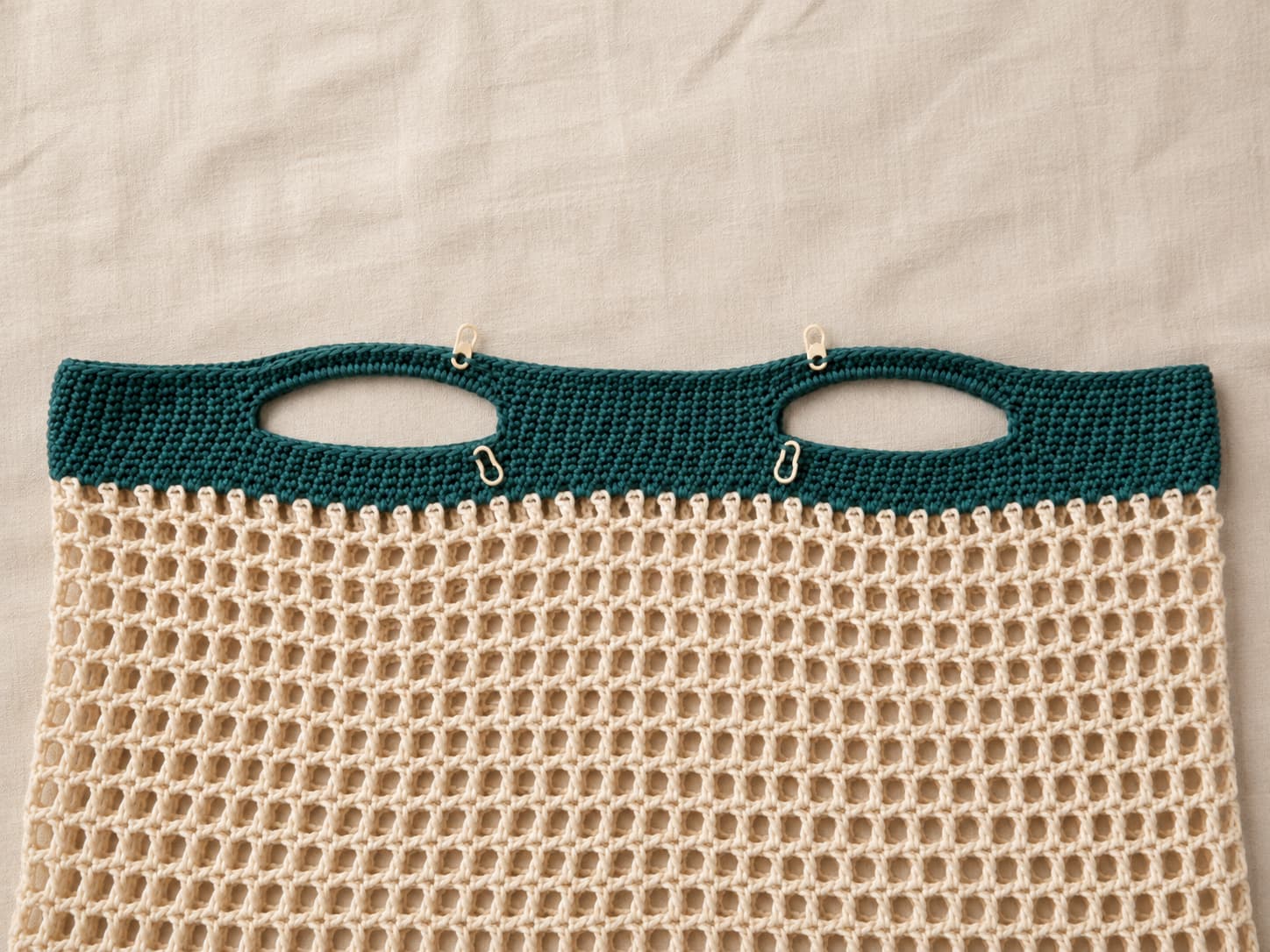
Deep jade-teal solid top band on a crochet market bag with four stitch markers showing two symmetrical eighteen-stitch handle openings.
Marking the two openings before chaining the handles keeps the front and back balanced.
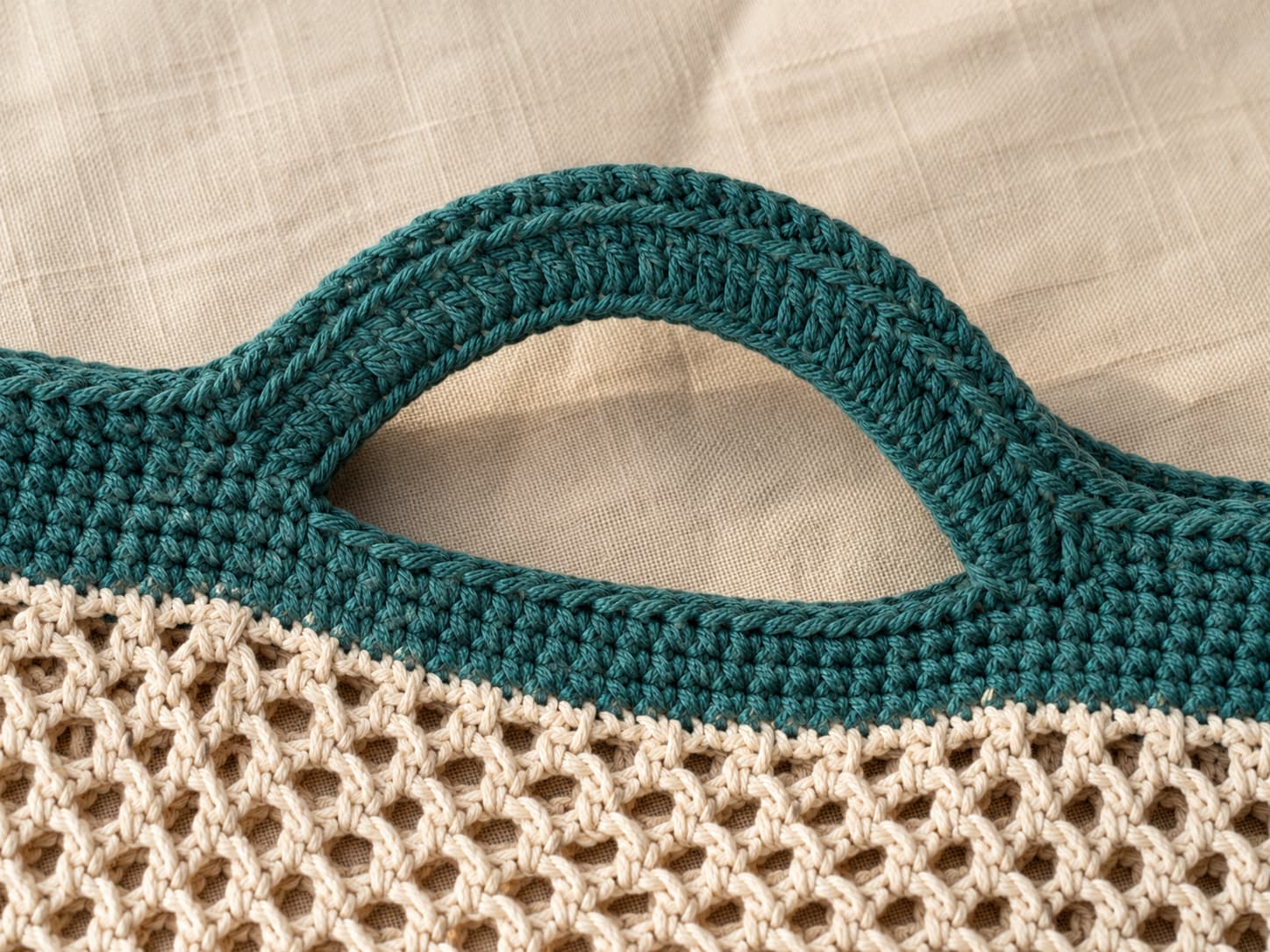
Close-up of a deep jade-teal integrated crochet handle with two single crochet reinforcement rounds and a centered surface slip-stitch ridge.
A second structural pass along the handle reduces edge rolling and helps the loop recover after carrying.

Before working the handle-opening round, fold the bag flat and confirm that the two skipped 18-stitch sections sit opposite each other. The following rounds should cover the chains evenly without forcing them shorter. A loose surface slip-stitch ridge can add structure, but a tight ridge will make the handle curl.

Finishing and testing

Wash, inspect, and increase the test load gradually

Finished jade and oatmeal crochet market bag being tested gradually with folded towels, boxed pantry items, and produce while the handle joins are inspected.
Test the finished sample progressively and publish a load claim only after repeat testing with the final yarn and construction.
  1. Weave every tail through multiple stitches in changing directions, especially at color changes.
  2. Wash according to the yarn label and dry completely.
  3. Inspect the magic-ring centre, top band, handle attachments, and surface reinforcement.
  4. Begin with folded towels, then add stable packaged items in small increments.
  5. Stop when a join distorts, the handle becomes uncomfortable, or the mesh does not recover.
  6. Repeat the test after several wash-and-dry cycles before stating a fixed capacity.
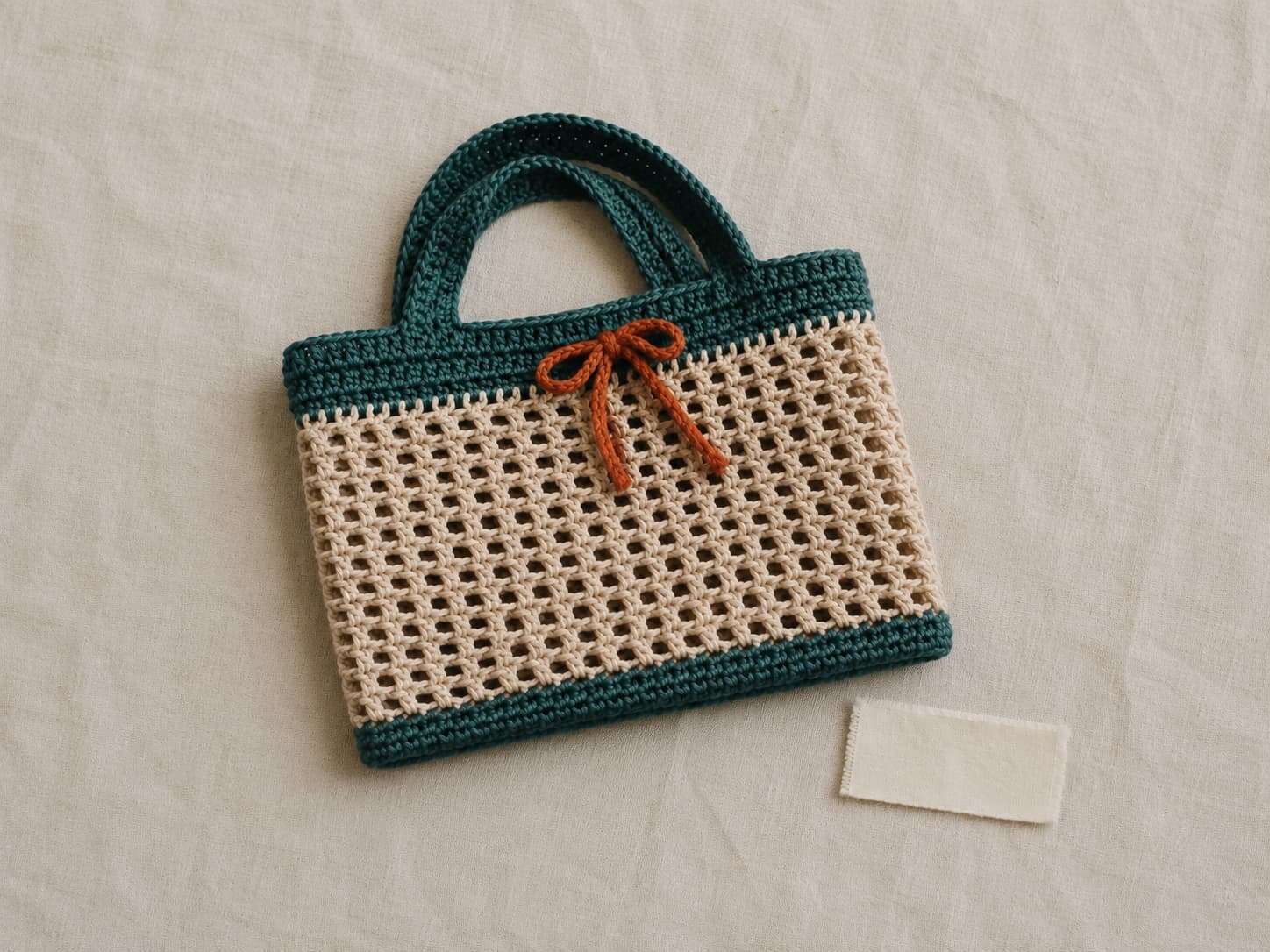
Washed and dried crochet market bag folded flat beside its care label, with deep jade-teal base and handles, warm-oatmeal mesh, and a small persimmon tie.
Record the dry dimensions after washing because cotton construction and finishing can change the final size.

Practice tips and variations

Change the styling without weakening the structure

One-color version

Work the complete bag in deep jade, natural cotton, or another medium-value color for fewer yarn ends.

Removable drawstring

Make a persimmon chain cord and weave it through the top band. Remove it before washing when the closure hardware is not washable.

Tighter mesh

Prototype a chain-three repeat before changing the full pattern because the anchor count and top-band conversion must also change.

Handle lining

For a separately tested heavy-use version, sew washable cotton twill tape inside the handles without relying on adhesive.

Troubleshooting

Six construction errors that affect shape and durability

Base stops at 48 stitches

At the reference gauge that produces a much smaller circle. Continue the six-increase progression to 72 stitches.

Wrong number of mesh spaces

The setup must produce 24 anchors and 24 chain-five spaces from the 72-stitch base.

Joining into a chain

Later mesh anchors go into the complete chain space, not a single chain, unless deliberately redesigning the mesh.

Unequal handle openings

Recount the 9–18–18–18–9 stitch distribution before completing the round.

Tight reinforcement

Surface slip stitches should support the handle without shortening it or causing the edges to roll.

Publishing an untested load rating

Strength depends on the complete sample, not only the written stitch count.

Common questions

Easy crochet market bag FAQ

1. Why does this pattern use seventy-two stitches for the base?

At the reference gauge, seventy-two single crochet stitches create a circumference close to eighteen inches, which produces a base near six inches across. A forty-eight-stitch circle would be noticeably smaller at the same gauge. Measure the washed sample and use the stated count rather than adding random increases.

2. Can I make the market bag in one color?

Yes. The jade-and-oatmeal sample is a styling choice. Work the entire bag in one smooth cotton yarn when you prefer fewer ends or want the mesh, base, and handles to look continuous.

3. Can I use a cotton blend?

A cotton–linen or cotton–synthetic blend may work when it produces a stable mesh and the care label suits the intended use. Make and wash a swatch, hang it with a modest test weight, and check whether it returns to shape before committing to the full bag.

4. How much weight will the bag hold?

The written pattern does not promise a universal weight rating because yarn strength, gauge, handle reinforcement, seam security, wear, and washing all matter. Test the final physical sample gradually with safe packaged items and publish a fixed rating only after repeat testing.

5. How can I make the mesh openings smaller?

Replace each ch-5 space with ch 3 and anchor into every second base stitch after recalculating the repeat around the top of the base. Make a sample section first; changing the mesh also changes width, stretch, yarn use, and the top-band stitch count.

6. How do I wash the finished bag?

Follow the yarn label. Place the bag in a mesh laundry bag to reduce tangling, secure any removable cord, and reshape it after washing. Do not assume that all cotton yarns tolerate the same water temperature or dryer setting.

7. May I sell bags made from this pattern?

You may sell finished physical bags made from the pattern. Do not republish or sell the written instructions, tables, or images. Credit Knitsoul as the pattern source when listing finished bags online.

Practical construction

Put dense fabric under the load and reinforcement around the hands

The bag succeeds when the base is large and flat, the mesh repeat remains consistent, the top returns to a solid stitch count, and the two handles are equal. Record how the exact yarn behaves after washing and use before treating performance estimates as final.

Happy crocheting,
— Sophie

Free printable

Track the base, mesh, handles, and physical test