Skip to the pattern

Free knit pattern · advanced beginner

Easy Knit Baby Blanket: Cloud Nine Stitch for Beginners

Knit a soft baby blanket with the original Cloud Nine Stitch — a simple 4-row repeat of stockinette and eyelet lines — framed by a seed stitch border, in baby-safe worsted yarn with row-by-row instructions.

Easy (advanced beginner)Knit flat4-row repeat30 × 36 in
Quick answerJump to pattern

Start here

An easy knit baby blanket is the perfect first big project for knitters ready to move beyond scarves

An easy knit baby blanket is a flat, rectangular project worked back and forth in rows, using simple knit and purl stitches plus one eyelet row that creates delicate horizontal lines across the fabric. The Cloud Nine Stitch — an original KnitSoul design — alternates smooth stockinette with evenly spaced eyelet rows every four rows, giving the blanket a light, breezy texture without any complicated shaping or colorwork.

Why this pattern works for an advanced beginner

In practice, this easy knit baby blanket pattern uses a 4-row repeat that you can memorize in minutes. Rows 1 and 2 are plain knit and purl (stockinette). Row 3 is the eyelet row: knit one, yarn over, knit two together, repeated across. Row 4 is purl. That is the entire stitch pattern. A seed stitch border at the top and bottom frames the eyelet fabric with a tidy, non-rolling edge.

For the photographed sample, soft cream worsted acrylic yarn forms the body, while pale sage frames the seed stitch border — two gentle, nursery-ready colors that photograph beautifully and feel soft against a baby’s skin. The finished blanket measures approximately 30 × 36 inches, a standard size for a crib or stroller blanket.
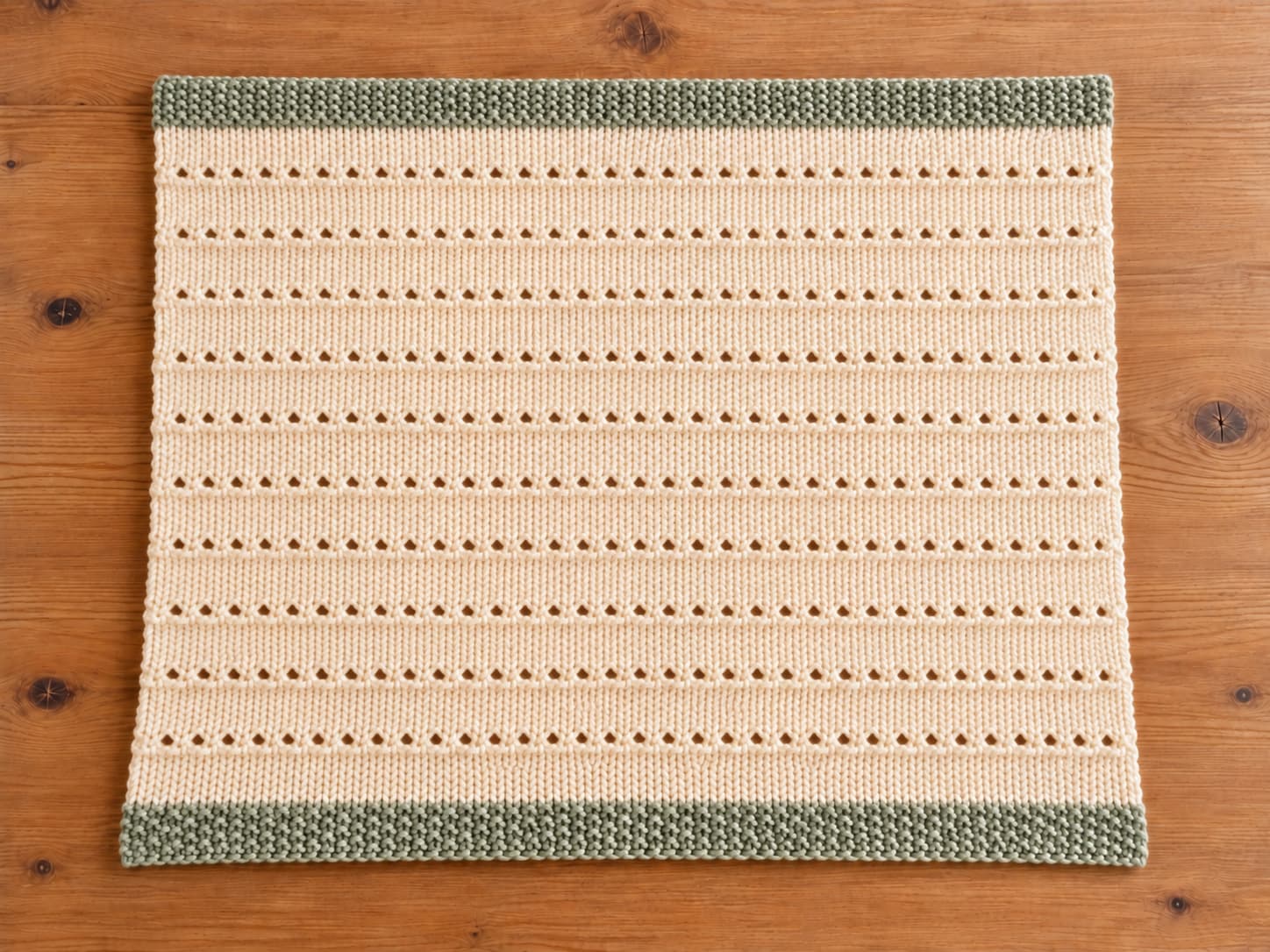
Finished cream knit baby blanket with evenly spaced horizontal Cloud Nine eyelet rows and pale sage seed stitch borders on a natural wood surface.
The Cloud Nine Stitch creates delicate horizontal eyelet lines across a smooth stockinette background — simple enough for an advanced beginner.

Pattern at a glance

Skill levelEasy (advanced beginner)

Knit, purl, yarn over, knit two together. No shaping.

Stitch patternCloud Nine Stitch

4-row repeat: stockinette + eyelet line every 4 rows.

ConstructionFlat, back and forth

Seed stitch border, Cloud Nine body, seed stitch border.

Finished size30 × 36 in / 76 × 91 cm

Standard baby blanket size for crib or stroller.

Yarn800–1,000 yd worsted (#4)

Baby-safe acrylic or cotton-acrylic blend.

Original motifCloud Nine Stitch

Original KnitSoul design. Not adapted from any source.
On this page

How it comes together

Construction overview: three sections, one simple flow

First, this easy knit baby blanket is worked flat in one piece from the bottom up. There are no seams to sew and no pieces to join. The construction has three sections: bottom border, body, and top border. Each section flows directly into the next, so you never break the yarn until the bind-off.

Cast on
135 sts
(US 7)
→
Seed stitch
border
6 rows
→
Cloud Nine
body
±216 rows
→
Seed stitch
border
6 rows
→
Bind off
loosely
in pattern

Bottom border

Six rows of seed stitch on US 7 needles create a flat, non-rolling edge at the cast-on. Seed stitch alternates knit and purl stitches, producing a textured bump pattern that looks the same on both sides.

Body

Next, switch to US 8 needles and work the Cloud Nine Stitch repeat until the body measures approximately 34 inches from the cast-on edge. The larger needle opens the eyelet fabric and gives the body a soft, flexible drape.

Top border

Finally, switch back to US 7 needles and work 6 rows of seed stitch to match the bottom border. Bind off loosely in pattern so the top edge does not cinch. The matching borders frame the eyelet body symmetrically.

Gather your supplies

Materials and yarn: baby-safe, soft, and easy to knit

What to look for in baby blanket yarn

To begin, choose a smooth, light-colored worsted-weight yarn so you can see every stitch as you learn the Cloud Nine Stitch. A yarn labeled machine-washable and baby-safe makes the finished blanket practical for real-life use — it will be washed often.

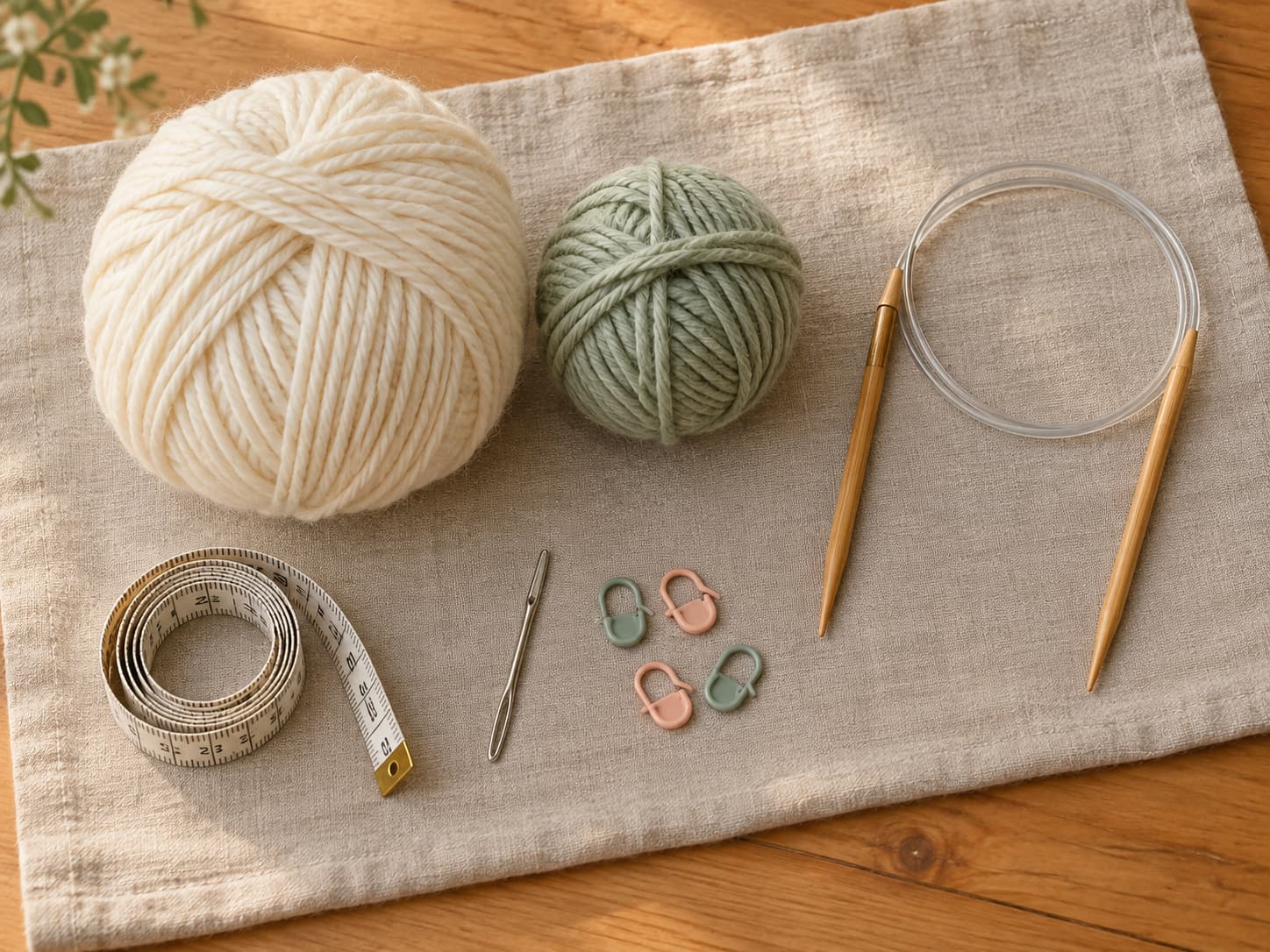
Worsted baby-safe yarn, circular knitting needles, tapestry needle, stitch markers, and measuring tape for an easy knit baby blanket.
Set out your yarn, needles, markers, tapestry needle, and measuring tape before you cast on.
ItemSpecificationPurpose
Yarn (body)800–1,000 yd / 730–915 m worsted weight (CYC #4), soft creamMain color for Cloud Nine body. Light color shows eyelet detail.
Yarn (border)50–80 yd / 46–73 m worsted weight (CYC #4), pale sageAccent color for seed stitch borders.
Needles (body)US 8 / 5.0 mm circular needle, 24–32 in cableUsed flat for Cloud Nine body. Circular holds all 135 sts.
Needles (border)US 7 / 4.5 mm circular needle, 24–32 in cableDenser gauge for seed stitch border.
NotionsTapestry needle, stitch markers (2 locking), measuring tape, scissorsMarking repeats, weaving ends, measuring length.

Three baby-safe yarn options

One option is Lion Brand Baby Soft — 60% acrylic, 40% nylon, 145 yd / 3.5 oz. This yarn was designed specifically for baby projects. The acrylic-nylon blend is machine washable and dryable, remarkably soft, and comes in a range of gentle pastels. Six or seven skeins cover the body of this easy knit baby blanket. The smooth strand makes it easy to see each eyelet as you work Row 3 of the Cloud Nine Stitch.

Another option is Bernat Baby Blanket Yarn — 100% acrylic, 220 yd / 6 oz. A chunky-style baby yarn, but worked on US 8 needles it produces a slightly looser, cloud-soft fabric that is perfect for the Cloud Nine Stitch name. Four or five skeins are sufficient. Machine wash and dry on delicate. This is the softest option and the most forgiving for beginners who knit tightly.

For more structure, Deborah Norville Everyday Worsted — 52% cotton, 48% acrylic, 180 yd / 3.5 oz. The cotton-acrylic blend gives the blanket a bit more weight and structure than pure acrylic, which helps it lie flat after blocking. Five or six skeins are needed. Machine wash cold, lay flat to dry. The cotton content makes stitch definition very clear — ideal for seeing the eyelet rows in the Cloud Nine Stitch.

Safety and yarn-planning checks

Measure before you commit

Sizing and gauge: swatch so the blanket comes out the right size

Target gauge and finished measurements

For consistent sizing, the target gauge is 18 stitches and 24 rows = 4 inches (10 cm) in stockinette stitch using US 8 needles. At this gauge, 135 stitches measure approximately 30 inches across. About 204 body rows measure approximately 34 inches, while the two seed-stitch borders bring the finished length close to 36 inches.

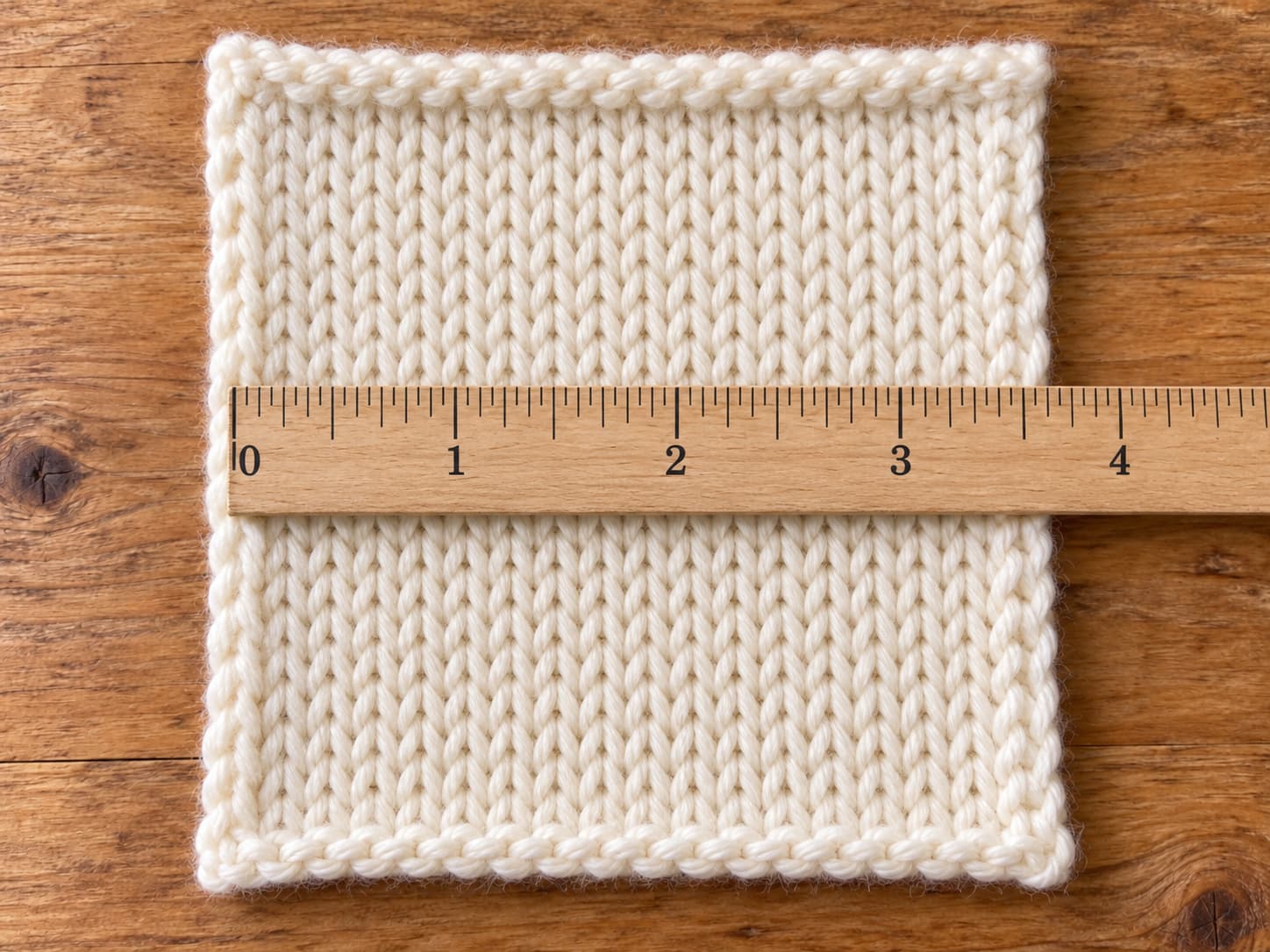
Stockinette gauge swatch measured for an easy knit baby blanket pattern with a ruler across the center.
Measure across the center of a relaxed swatch, not along the curling edges.
MeasurementTargetNotes
Stitch gauge18 sts = 4 in / 10 cmIn stockinette with US 8 needles, after washing.
Row gauge24 rows = 4 in / 10 cmIn stockinette with US 8 needles, after washing.
Width30 in / 76 cm135 sts at 4.5 sts per inch.
LengthApprox. 36 in / 91 cmAbout 34 in of body plus the top and bottom borders.
Border widthApprox. 1 in / 2.5 cm6 rows of seed stitch on US 7 needles.

How to make and measure your swatch

First, with US 8 needles and your body yarn, cast on 28 stitches. Work 32 rows in stockinette (knit on RS, purl on WS). Bind off loosely. Wash and dry the swatch the same way you will care for the finished blanket. Lay it flat without stretching, then measure 4 inches across the center and count the stitches. Measure 4 inches vertically and count the rows.

Next, if you have more than 18 stitches in 4 inches, try US 9 needles. If you have fewer than 18 stitches, try US 7 needles. Stitch gauge controls the width of the blanket; row gauge can be adjusted by working more or fewer repeats to reach the target length. Review the how to knit for beginners guide if you are new to swatching.

Plan alternate blanket sizes from your gauge

VersionWidthCast onBody rows (approx.)
StrollerApprox. 24–25 in / 61–63 cm111168–172
Standard (this pattern)30 in / 76 cm135204
CribApprox. 36–37 in / 91–93 cm165204
Small throwApprox. 40–41 in / 102–103 cm183240

The stitch that gives this blanket its name

Cloud Nine Stitch technique: a 4-row repeat with one easy eyelet row

At the center of this blanket, the Cloud Nine Stitch is an original KnitSoul stitch pattern that creates a stockinette base with delicate horizontal eyelet lines every four rows. It is designed for this easy knit baby blanket and is not adapted from any third-party source. The name comes from the soft, airy quality the eyelet lines give the fabric — like lying on a cloud.

The 4-row repeat

Cloud Nine Stitch — 135-stitch blanket setup:

Row 1 (RS): Knit across.

Row 2 (WS): K1, purl to last st, k1.

Row 3 (RS): K1, *k1, yo, k2tog; repeat from * to last 2 sts, k1, k1.

Row 4 (WS): K1, purl to last st, k1.

Repeat Rows 1–4 for the Cloud Nine Stitch pattern.

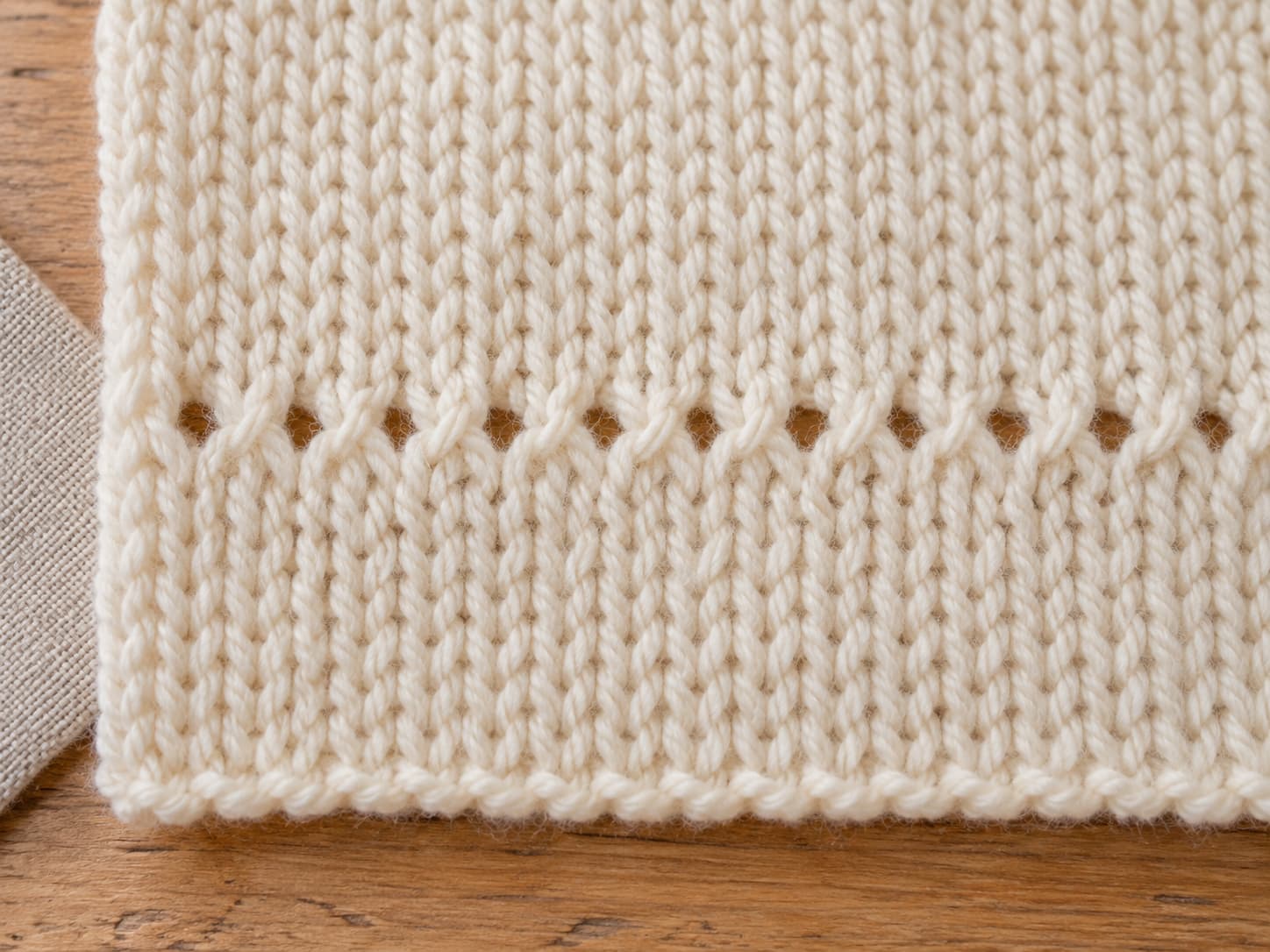
Close-up of Cloud Nine Stitch showing smooth stockinette rows with a delicate horizontal eyelet line in soft cream yarn.
Every fourth row, the yarn over and knit two together create a row of small eyelets across the fabric. The remaining rows are smooth stockinette.

How the eyelet row works

Importantly, Row 3 is the only row that uses yarn over (yo) and knit two together (k2tog). These two moves work as a pair: the yarn over creates a new stitch (and a small hole), and the knit two together decreases one stitch. Because every increase is matched by a decrease, your stitch count stays the same at the end of every row — no shaping, no counting anxiety. The odd stitch count ensures the repeat works cleanly across, with a final knit-one at the end.

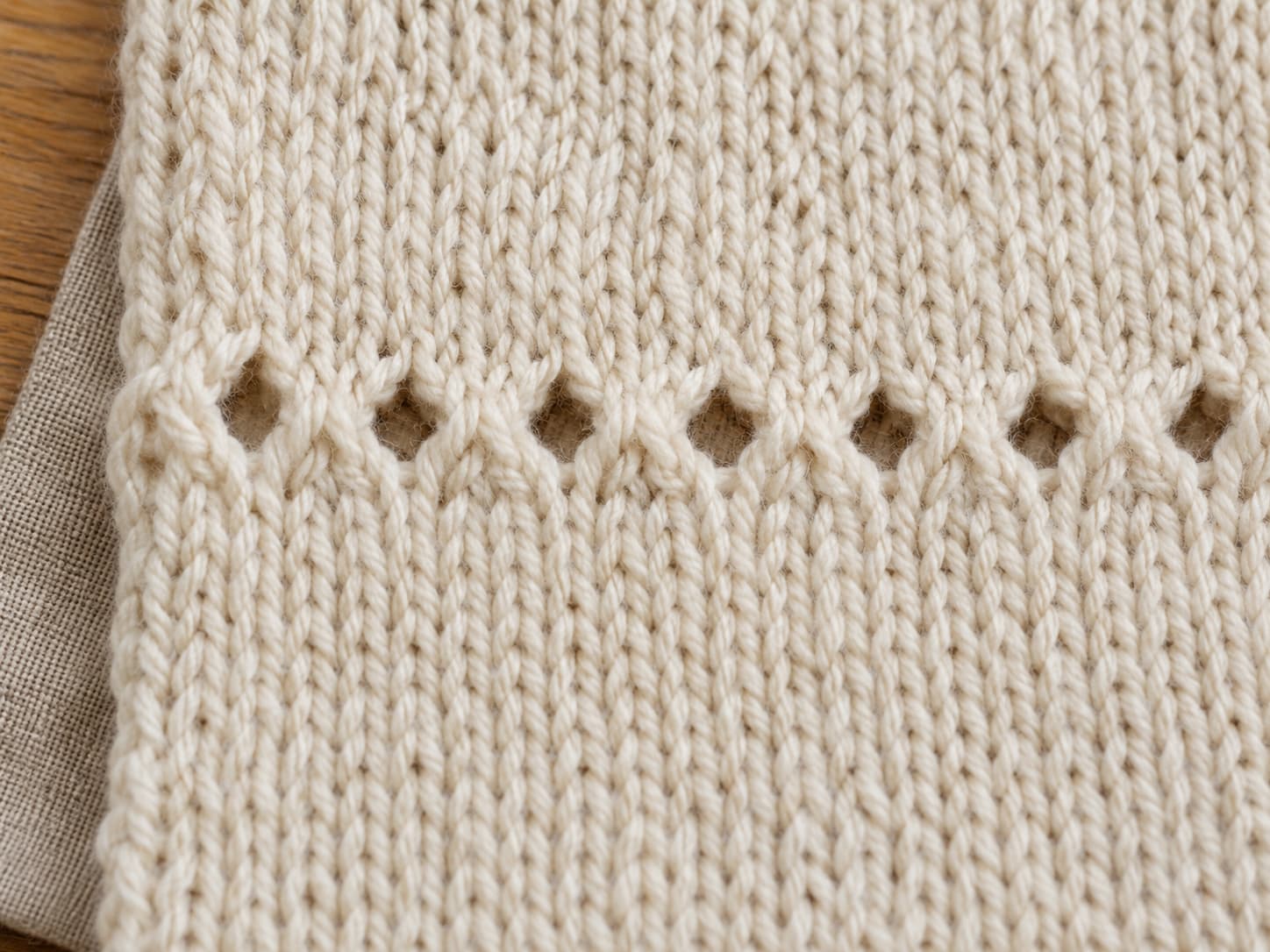
Detail of the Cloud Nine Stitch eyelet row showing yarn over holes and knit-two-together decreases in soft cream worsted yarn.
The yarn over creates a decorative hole; the k2tog leans right and keeps the stitch count balanced.

Seed stitch border

Meanwhile, seed stitch alternates knit and purl stitches, staggering them so every knit sits above a purl and vice versa. The result is a textured, reversible fabric that never rolls. For this easy knit baby blanket, work seed stitch over 6 rows at the cast-on and again at the top, using US 7 needles and the sage yarn. The tighter gauge and contrasting color make the borders pop against the cream eyelet body.

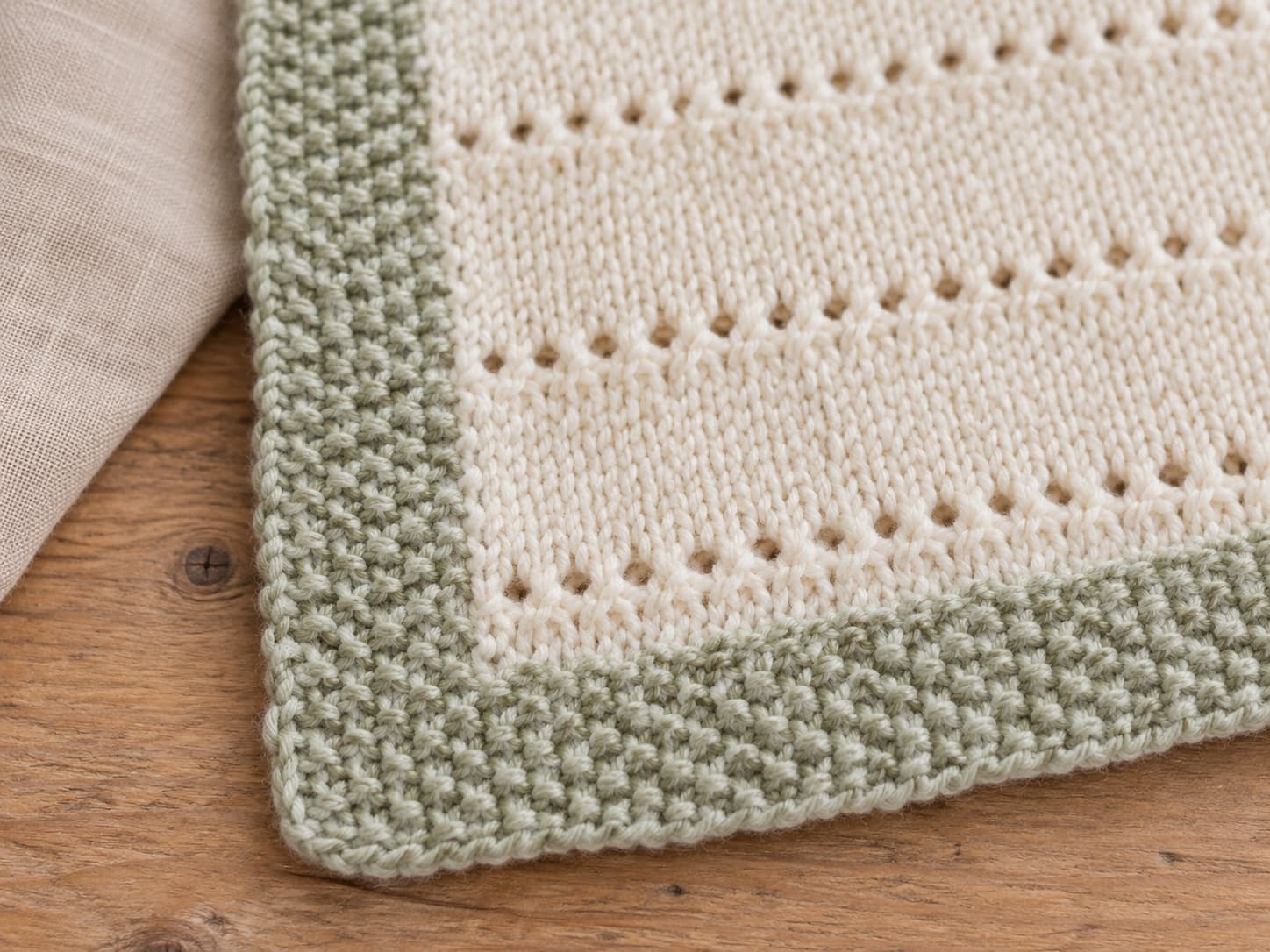
Pale sage seed stitch border at the edge of a cream Cloud Nine Stitch knit baby blanket showing the bumpy alternating texture.
Seed stitch creates a tidy, non-rolling edge. The contrasting sage yarn frames the cream body.

Free pattern

Complete easy knit baby blanket pattern: Cloud Nine Stitch with seed stitch border

KnitSoul free pattern

Cloud Nine Baby Blanket

TermsU.S. knitting terms
ConstructionFlat, bottom up, one piece
Stitch count135 sts (odd number)
Finished sizeApprox. 30 × 36 in / 76 × 91 cm

Bottom border — Seed stitch (6 rows)

With sage yarn and US 7 / 4.5 mm needles, cast on 135 stitches loosely.

Rows 1–6: Work in seed stitch as follows: *K1, p1; repeat from * to last st, k1. (Every row is the same: knit the purls and purl the knits as they face you.)

Cut the sage yarn, leaving a tail to weave in later. Rejoin sage when you begin the top border.

Body — Cloud Nine Stitch

Next, switch to cream yarn and US 8 / 5.0 mm needles. Knit the first and last stitch of every body row to create a simple garter-stitch selvedge.

Row 1 (RS): K1 (edge), knit across to last st, k1 (edge).

Row 2 (WS): K1 (edge), purl across to last st, k1 (edge).

Row 3 (RS): K1 (edge), *k1, yo, k2tog; repeat from * to last 2 sts, k1, k1 (edge).

Row 4 (WS): K1 (edge), purl across to last st, k1 (edge).

Repeat Rows 1–4 until the body measures approximately 34 inches (86 cm) from the bottom border, ending with a complete 4-row repeat. At the target row gauge, this is about 51 repeats (204 rows).

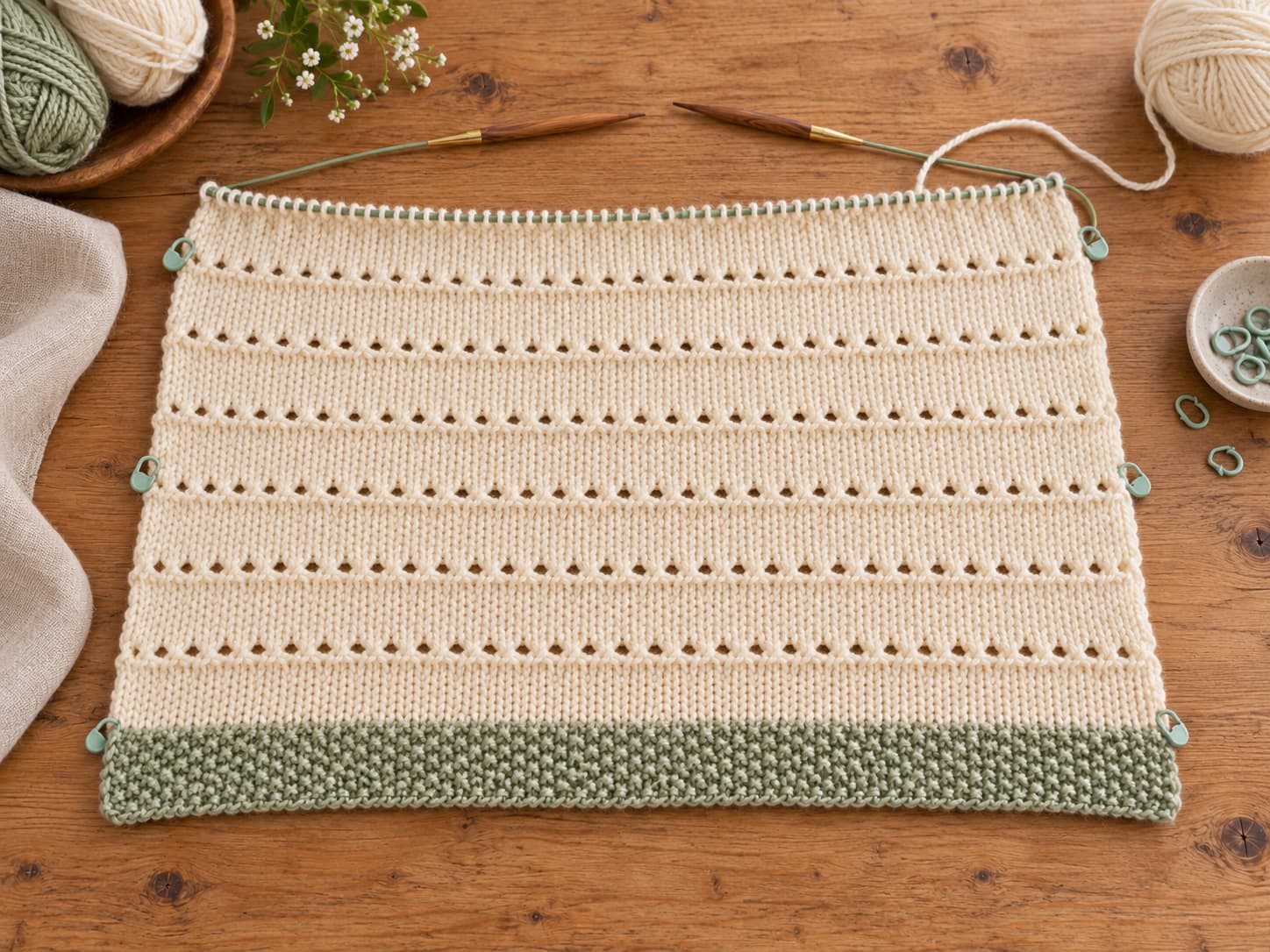
Easy knit baby blanket in progress on circular needles showing Cloud Nine Stitch eyelet rows and straight edges with stitch markers.
Count your stitches at the end of each eyelet row to confirm the stitch count has not changed. Place a marker every 20 stitches to make counting fast.

Top border — Seed stitch (6 rows)

Finally, switch to sage yarn and US 7 / 4.5 mm needles.

Rows 1–6: Work in seed stitch as follows: *K1, p1; repeat from * to last st, k1. (Every row: knit the purls and purl the knits.)

Bind off

Then, bind off loosely in pattern (knit the knits, purl the purls as you bind off) to keep the top edge from cinching. If your bind-off tends to be tight, use a needle one size larger (US 8) for the bind-off row only. Cut the yarn, leaving a 10-inch tail, and pull it through the last stitch.

The final steps

Finishing and blocking: the steps that make it gift-ready

After the knitting is complete, finishing this easy knit baby blanket takes three steps: weave in all loose ends, wet block the blanket to open the eyelets and even out the fabric, and confirm the final measurements. Each step is straightforward, and together they transform the blanket from a knitted piece into a polished gift.

Weave in ends

First, thread a tapestry needle with each loose yarn tail. Weave the tail along the same row or column for at least 2 inches, then turn and weave back in the opposite direction for another inch. Trim the remaining tail close to the fabric. There are two color-change points (bottom border to body, body to top border) where you will have ends from both the sage and cream yarns. Weave each color into its own section of the blanket — do not cross the border-body boundary with a contrasting color tail.

Wet block

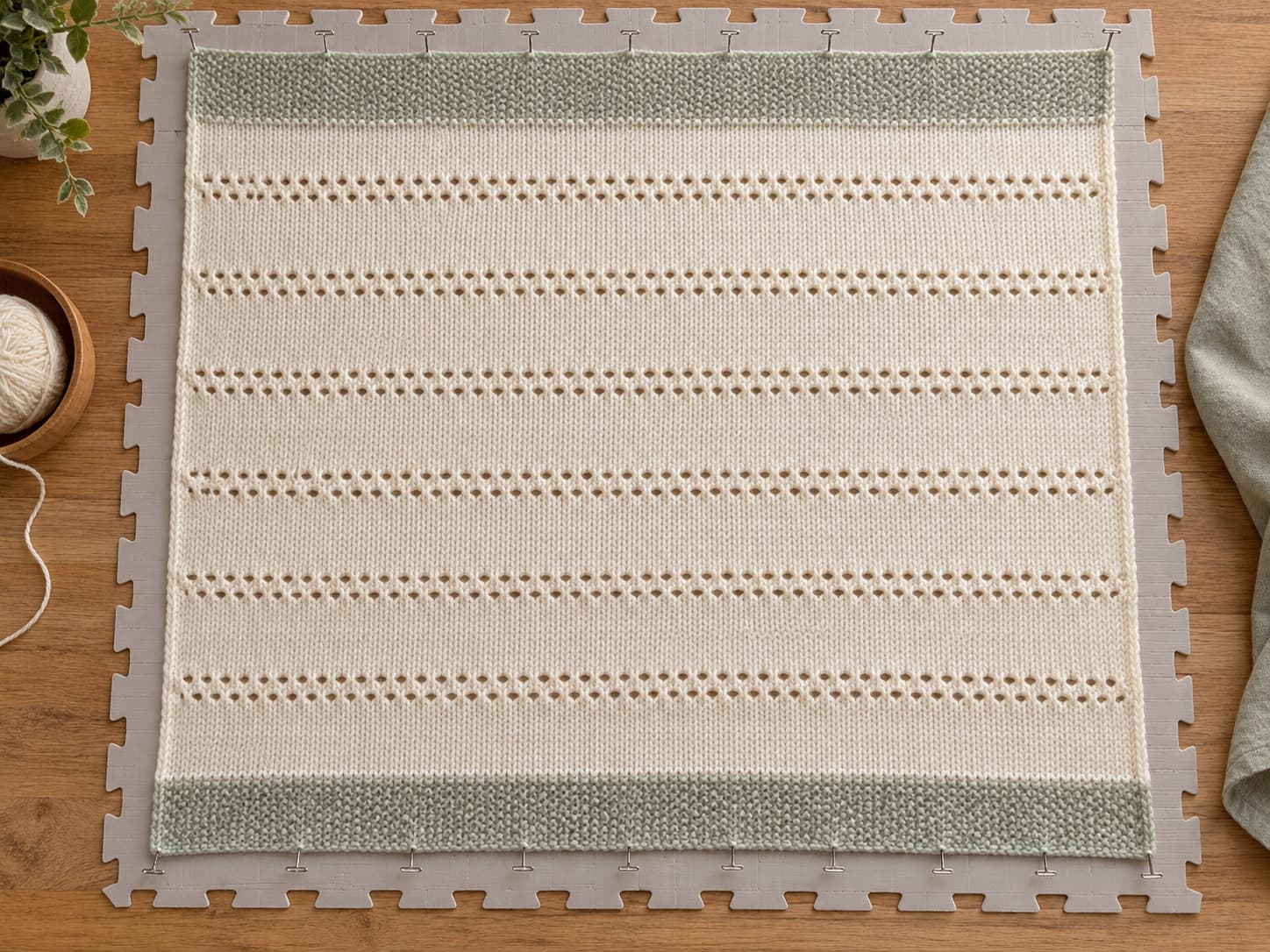
Next, submerge the blanket in cool water with a drop of wool wash or baby-safe detergent for 15–20 minutes. Gently squeeze out the water — do not wring or twist. Roll the blanket in clean towels and press to remove excess moisture. Lay it flat on blocking mats or a clean towel, shaping it to the target dimensions of 30 × 36 inches. Pin the corners and edges with rust-proof pins, spacing them every 3–4 inches. Let it dry completely, which may take 24–48 hours depending on humidity.

Finished cream knit baby blanket pinned flat for blocking, showing horizontal Cloud Nine eyelet rows and pale sage seed stitch borders.
Blocking opens the eyelet holes evenly, smooths the stockinette, and sets the blanket to its final dimensions.

Confirm measurements and care label

Finally, after the blanket is dry, measure it one more time. If it is significantly smaller than 30 × 36 inches, you can re-wet and re-block with more aggressive stretching. If it is larger, re-block with less tension. Attach a small care tag with washing instructions (machine wash cold, lay flat to dry, or follow your yarn label) and the fiber content.

Troubleshooting

Six mistakes that can change the look or size of your easy knit baby blanket

Stitch count changes after the eyelet row

For example, if you accidentally drop the yarn over or forget the k2tog on Row 3, your stitch count will change. The yo and k2tog must always work as a pair. Count your stitches at the end of every Row 3 — you should always have 135. Review how to read knitting patterns if abbreviations are new to you.

Tight bind-off that curls the top edge

As a result, a tight bind-off makes the top edge cinch inward and curl. Bind off loosely in pattern, and use a needle one size larger for the bind-off row if your tension tends to be tight. The edge should have the same flexibility as the fabric below it.

Uneven eyelet sizes

Similarly, if some yarn overs are larger or smaller than others, the eyelet line will look irregular. Work each yarn over with the same motion — bring the yarn forward between the needles, then over the right needle to the back. Consistent motion creates consistent holes.

Skipping the gauge swatch

Without a swatch, however, your easy knit baby blanket may turn out several inches wider or narrower than 30 inches. Even a half-stitch-per-inch difference compounds across 135 stitches. Always swatch, wash, and measure before casting on the full blanket.

Border in the same needle size as the body

In addition, if you use US 8 needles for the seed stitch border, it will be looser than the body and may not lie flat. The border needs the denser US 7 gauge to create a firm, non-rolling frame around the softer eyelet fabric.

Working seed stitch in the round by mistake

Finally, remember that this blanket is worked flat, back and forth. Every seed stitch row is the same: knit the purls and purl the knits as they face you. Do not alternate rows the way you would for 1×1 ribbing. If the border looks like ribbing instead of bumpy seed stitch, you are alternating the pattern instead of working every row the same.

Make it your own

Practice tips and variations: customize your easy knit baby blanket

Larger size (crib or throw)

For a larger version, use the planning table above as a starting point, then swatch before casting on. Keep the cast-on compatible with the Cloud Nine eyelet repeat and the seed-stitch border, and adjust the number of 4-row repeats for the desired length.

Garter stitch border

Alternatively, replace the seed stitch border with garter stitch (knit every row) for a simpler alternative. Garter stitch is even easier for beginners because every row is the same. Work 8–10 rows of garter stitch for the same approximate border width. Garter does not curl and looks clean on both sides.

Striped version

For color variation, alternate two or three colors in the Cloud Nine body, changing yarns at the end of a WS row (Row 2 or Row 4). Plan stripes in multiples of 4 rows so each color completes a full repeat. This avoids a color break in the middle of the eyelet row, which can look messy. Carry the unused color up the side edge.

Different eyelet spacing

For example, for more eyelet lines, place the eyelet row every 2 rows instead of every 4: Row 1 knit, Row 2 [k1, yo, k2tog] across, repeat. For fewer eyelet lines, place it every 6 or 8 rows. More eyelets create a lacier look; fewer eyelets make the blanket warmer and more solid. The Cloud Nine Stitch as written (every 4 rows) is the balanced middle ground.

Five practice tips

  • Count stitches at the end of every eyelet row. First, make this the most important habit for this pattern. If the count is off, the error happened on Row 3 and is easy to find and fix right away. Waiting until the end of the blanket means frogging hundreds of rows.
  • Place markers every 20 stitches. Next, when you cast on 135 stitches, place a marker after stitch 20, 40, 60, 80, 100, and 120. This lets you count in small batches instead of all 135 at once. Move the markers up every few repeats.
  • Use a row counter. In addition, a row counter that slides onto your needle makes it easy to track which row of the 4-row repeat you are on. Reset it after every Row 4. If you lose count, look at the fabric: the eyelet row is always Row 3, and the row after the eyelets is always Row 4 (purl).
  • Practice the eyelet row on a small swatch first. Before the full blanket, cast on 21 stitches and work 8–10 rows of the Cloud Nine Stitch before starting the blanket. This builds muscle memory for the yo and k2tog so you can work Row 3 confidently on the real project. See the how to knit for beginners guide for basic stitch practice.
  • Block before you decide the blanket is finished. Finally, blocking transforms the fabric — it opens the eyelets, smooths the stockinette, and sets the final dimensions. The blanket will look different after blocking, so do not judge the eyelets until the blanket is pinned and dry. Follow the full instructions in the blocking guide.

Common questions

Easy knit baby blanket FAQ

Getting started with the pattern

1. Is this easy knit baby blanket pattern suitable for a beginner?

Yes. This easy knit baby blanket uses only knit, purl, yarn over, and knit two together — four of the most basic knitting skills. There is no shaping, no seaming, and no colorwork in the body. The 4-row repeat is memorizable in minutes. If you have completed a garter stitch scarf and are comfortable with purl, you can knit this blanket. Review the how to knit for beginners guide if you need a refresher on any of the stitches.

2. How long does it take to knit this baby blanket?

Most advanced beginners finish this easy knit baby blanket in 20–30 hours of knitting time, spread over one to three weeks of casual evening knitting. The seed stitch borders take about 1–2 hours each, and the Cloud Nine body takes the remaining time. Faster knitters may finish in 15–20 hours. This is a planning estimate, not a tested promise — your time depends on your knitting speed, tension, and how many rows per sitting you typically work.

3. Can I use circular needles for a flat blanket?

Yes — and you should. Circular needles are the standard choice for flat blanket knitting because the cable holds all the stitches without bunching, and the weight of the blanket rests in your lap rather than on your wrists. You work back and forth in rows just as you would on straight needles, turning the work at the end of each row. Use a 24–32 inch circular needle for this 135-stitch blanket. See the crochet hooks and knitting needles guide for more needle guidance.

Choosing tools, yarn, and the right approach

4. Knit vs. crochet baby blanket — which is easier for a beginner?

Both have similar learning curves for a first blanket, but they feel different. A knit baby blanket (like this one) has a smoother, stretchier fabric with smaller stitch definition — ideal for lightweight, draping blankets. A crochet baby blanket works up faster stitch-for-stitch but produces a thicker, denser fabric with larger visible stitches. Knitting requires keeping all live stitches on the needle (mistakes can unravel), while crochet has only one live stitch at a time (mistakes are easy to fix). If you want to try both, start with the easy crochet baby blanket for a quick win, then come back to this knit version for a smoother fabric.

5. What yarn weight is best for a knit baby blanket?

Worsted weight (CYC #4) is the sweet spot for a knit baby blanket. It is thick enough to work up at a reasonable pace, thin enough for a soft, flexible fabric, and widely available in baby-safe acrylics and cotton blends. DK weight creates a lighter blanket but takes longer to knit. Bulky weight works up fast but can feel stiff and heavy for a baby. The Craft Yarn Council yarn weight system has the official CYC standards.

6. May I sell finished items made from this pattern?

You may sell finished physical items made from this pattern. Do not copy, redistribute, or sell the written pattern, stitch instructions, or images. Credit KnitSoul as the design source when listing finished items online.

Your first big knit

An easy knit baby blanket is the project that turns a scarf knitter into a blanket knitter

In short, the Cloud Nine Stitch makes it possible: a 4-row repeat with one easy eyelet row that creates a beautiful, professional-looking fabric without any complicated techniques. Cast on, work the repeat, add the border, bind off, and block. Every step is within reach of an advanced beginner, and the finished blanket is something you will be proud to give — or to keep for your own little one.

Therefore, start with a swatch, trust the repeat, count after every eyelet row, and block before you judge. The Cloud Nine Stitch will carry you through the long middle rows, and by the time you bind off, you will have the confidence to knit anything flat.

Happy knitting,
— Sophie

Free printable

Keep the Cloud Nine Stitch reference and pattern checklist beside your knitting